
Go to documentation repository


Page History
| Section | |||||||||||||||||||||
|---|---|---|---|---|---|---|---|---|---|---|---|---|---|---|---|---|---|---|---|---|---|
|
The You can add the Video capture device object for grabbing receiving video image from all Server server displays/monitors via the FFMPEG driver can be added either by manually creating by creating and configuring the Video capture device object or using the Camera discovery tool. The latter way is preferable.
The Besides, the driver also supports capturing system sounds and sounds from the computer 's microphone. Audio The audio input and output format is PCM. The For this, except for the Video capture device object, you must create and configure the Audio card and Microphone objects should also be created and configured in addition to the Video capture device object in order to use this functionality. This can also be done using the Camera . You can also do it by using the camera discovery tool. To capture system sounds, you configure must preconfigure the system accordingly (see below).
...
Preconfiguring the system for capturing
...
system
...
sounds
In order to To capture system sounds, you must enable the Stereo Mix device as follows:in the system in the following way:
Open the Sound window and go to the Recording tab.
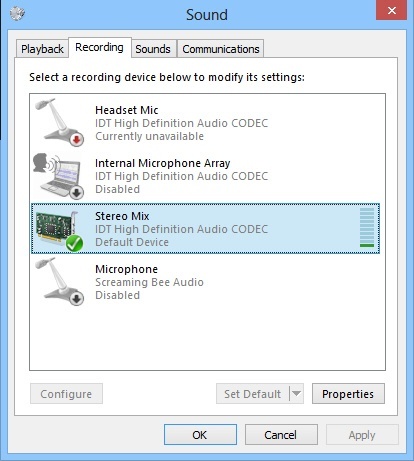
Info title Note Go to the Recording tab in the Sound window.
Note.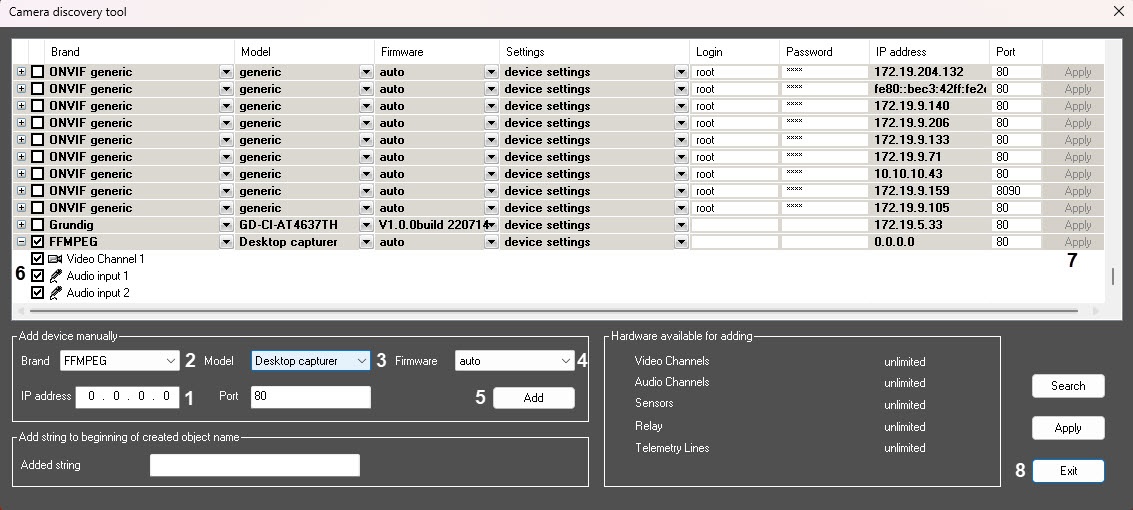
in order toIn Windows 7,
, selectyou can open this window
by selecting the Recording Devices item in the menu that opens when you right-click the speaker icon.
If there is no Stereo Mix device on the Recording tab, right-click any empty space in the list and select Show Disabled Devices.
If the Stereo Mix device is disabled, right-click it and select Enable.
If the Stereo Mix device has any other name, rename it to "Stereo Mix" (case-sensitive); to do so, right-click the device then select Properties and enter the new name in the text field.
Click the Apply button in the Sound window.
Creating the Video capture device and Audio card
...
objects
Add To add the Video capture device object for grabbing video image from application windows and receiving video from all server displays/monitors and the Audio card and Microphone objects for grabbing sounds capturing sound via the FFMPEG driver as follows, do the following:
- Start Open the Camera discovery tool.
In Enter any IP address in the IP address field (1), enter any IP address. The driver automatically sets the proper required address for this model.
Info title Note. When adding you add a device of this device type by manually creating the Video capture device object, set the following IP address: you must specify the gdigrab://desktop address in the IP address field.
- From the Brand drop-down list (2), select the FFMPEG (2)value.
- From the Model drop-down list (3), select the Desktop capturer (3)model.
- From the Firmware drop-down list (4), select the auto (4)firmware.
- Click the Add button (5). The device is added to the list.
- Set the checkbox next to the added device and the required child objects you need (6):
- Select the Video channel 1 object if you want to capture video;.
- Select the Audio input 1 to object if you want to capture audio from the speaker selected as the default output device in the system;.
Select the Audio input 2 to object if you want to capture audio from the microphone selected as the default device (not communication) in the system.
Note title Important. Attention! You can detect the The default microphone/speaker is defined when adding a when you add the Video capture device object. If you switch the default microphone/speaker (for example, by connecting a the USB camera or the microphone/speaker connector , or simply changing the system settings) after that without unloading Axxon PSIM, then switching to the new default device will NOT be device ISN'T performed automatically. To update the linked input/output device, restart you must restart Axxon PSIM or delete the Video capture device and Audio card objects and re-add them.
- Click the Apply button (7).
- Click the Exit button (8).
Additional
...
features of the FFMPEG device
The address with additional options for You can manually set the address line by including the ffmpeg utility can be specified options to it in the IP address field on the settings panel of the Video capture device object settings panel. In this case, the address has looks in the following formatway:
gdigrab://desktop: [-additionalOptions]
For example, you can set a specific area can be set with and several other options.
The Below is the list of options supported by the ffmpeg library for the gdigrab mode:
- -draw_mouse <int> draw the mouse cursor (from 0 or to 1) (1 by default);
- -show_region <int> draw borders across the capture line (from 0 or to 1) (0 by default);
- -framerate <video_rate> set the frame rate ("ntsc" ntsc” by default);
- -video_size <image_size> set the frame size;
- -offset_x <int> indent along the x axis of the capture area (from INT_MIN to INT_MAX) (0 by default);
- -offset_y <int> indent along the y axis of the capture area (from INT_MIN to INT_MAX) (0 by default);
Example of the value for the "additionalOptions" additionalOptions” property:
-draw_mouse 1 -show_region 1 -framerate 25 -video_size 640x480 -offset_x 10 -offset_y 10
...
Overview
Content Tools