
Go to documentation repository


Page History
...
By default, the entire frame is a detection area. If necessary, in the preview window, you can set one or more skip more ignore areas (see Configuring a skip the ignore area).
To save the parameters of the detector, click the Apply  button. To cancel the changes, click the Cancel
  button.
...
- In the preview window:
- Specify the end points of the line
 :
: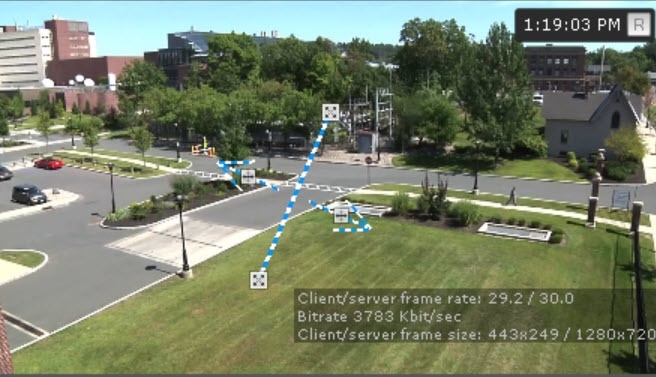
Info title Note - The end points are connected by a two-color dashed line. The directions of object movement through the line are indicated by dotted arrows.
- For convenience of configuration, you can "freeze" the frame. Click the
 button. To cancel the action, click this button again.
 - To hide the virtual line, click the
 button. To cancel the action, click this button again.
Action Result Hover the cursor over the end point and, holding down the left mouse button, move the mouse Moving the end point of a line Hover the cursor over the line and, holding down the left mouse button, move the mouse Moving the line - By default, both directions of object movement through the line are detected. To stop the detection in the required direction, click the
 button corresponding to this direction.
Note title Attention! - You must select at least one direction for detection.
- An unmonitored direction of object movement is indicated by a dimmed arrow.
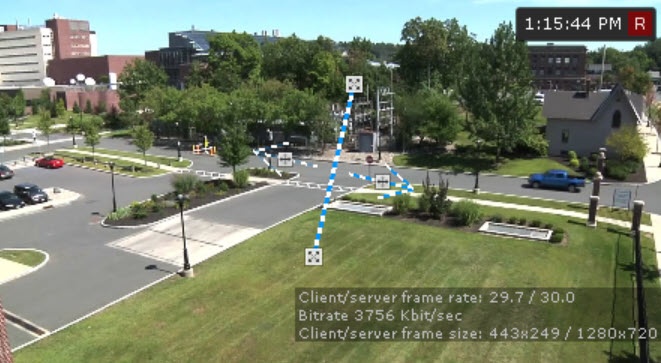
- Specify the end points of the line
- In the frame, there can be situations when one and the same object frequently moves near the virtual line, which can cause the generation of excessive events. In this situation, we recommend specifying the area of the object track that completely crosses the line to receive an event from the detector. For this, in the detector parameters, specify the X-axis and Y-axis offsets as a percentage of the track area width and height.
Configuration of the X-axis and Y-axis offsets depends on the Camera position parameter of the parent detector below which the Line crossing detector is created. For example, Neural tracker has the Camera position parameter (see Configuring the Neural tracker).- The Ceiling camera position:
For example, the green rectangle is the object track. If the X-axis and Y-axis offsets are set to 25%, an event is generated only if the red rectangle completely crosses the line.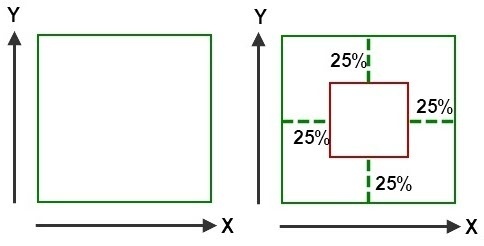
- The Wallcamera position:
For example, the green rectangle is the object track. If the X-axis offset is set to 30%, an event is generated only if the red segment completely crosses the line.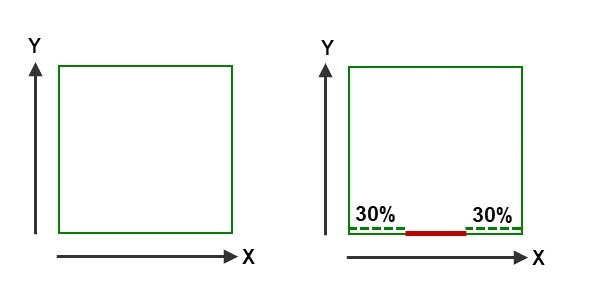
- The Ceiling camera position:
- Click the Apply button. Click the Cancel button to cancel the changes.
...
Overview
Content Tools