
Go to documentation repository

Documentation for Monitoring PSIM 2.0 (english)
Previous page Next page

To play back live video and an archive from a specific camera, select the name of the corresponding camera in the Video image playback menu (see Viewing objects' live video and archives).
After you select a camera, a dialog box opens. Wait for several seconds for the video to start.
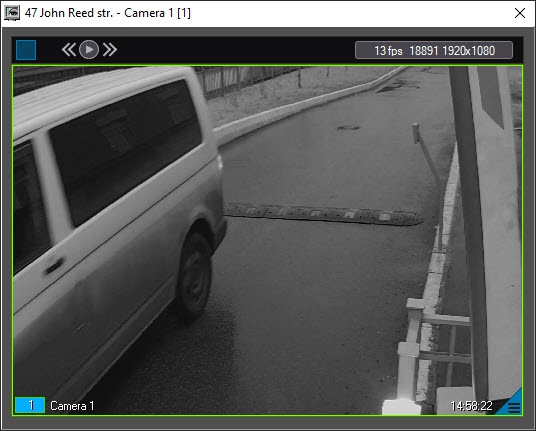
The window's title shows the description of the object, the camera order number, and the camera ID in brackets. You can access the archive using the standard Axxon PSIM method.
Note
- To view live video in full-screen mode, double-click on it.
- To exit the full-screen mode and go back to the window playback mode, do the following:
- Double-click on the video using the right mouse button. You can use it both for specific cameras and for "All cameras" or "All cameras of the partition of control" modes;
- Double-click the left mouse button by holding down the Ctrl key. You can use it only for specific cameras or layouts.
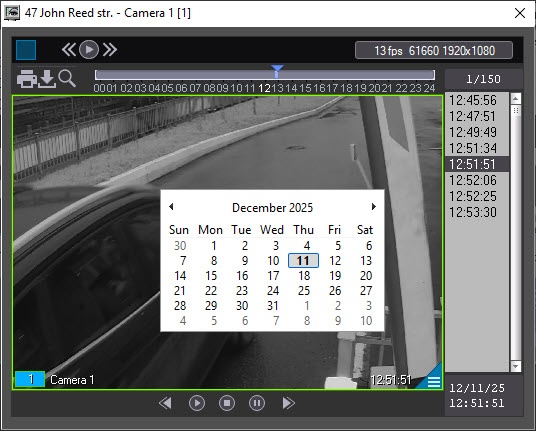
For details on how to work with surveillance windows and archives, see Axxon PSIM. Operator's Guide.
- When viewing live video, the frame rate can be limited by the settings of the Monitoring interface object (Video stream speed parameter), see Monitoring PSIM. Administrator's Guide.
- By default, the video clips and frames are exported to the <Axxon PSIM installation directory>\export folder. To change the folder for the exported video clips and frames, specify the required path in the StreamViewerExportPath registry key (see Registry keys reference guide; for more details on how to work with the registry, see Working with Windows OS registry).
- By default, the StreamViewer live video viewer module runs with normal (medium) priority. To lower the priority, change the value of the StreamViewerLowestPriority registry key (see Registry keys reference guide; for more details on how to work with the registry, see Working with Windows OS registry).
Overview
Content Tools