
Go to documentation repository
Previous page Next page
Configuration of the Equipment detection (PPE) module includes: general detector settings, selection of the area of interest, and neural network configuration.
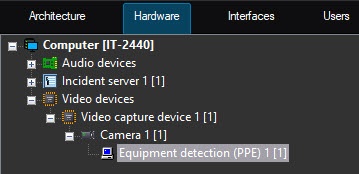
You can conigure the Equipment detection (PPE) module on the settings panel of the Equipment detection (PPE) object that is created on the basis of the Camera object on the Hardware tab of the System settings window.
General configuration of the detector is performed on the Detection settings tab on the settings panel of the Equipment detection (PPE) object.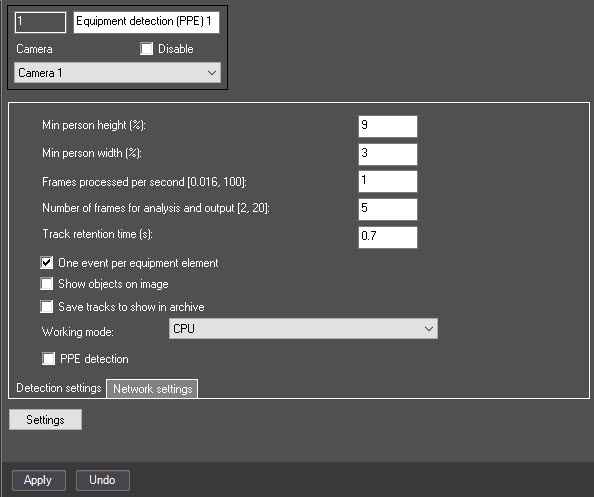
In the Number of frames for analysis and output [2, 20] field, specify the minimum number of frames on which the detector must detect a violation so that an event is generated in the range from 2 to 20.
By default, the One event per equipment element checkbox is set, and the detector generates an event once for each equipment element violation within one object (track). If you want the detector to generate an event each time the equipment violation occurs, clear the checkbox.
Example
A person appeared in a frame without a helmet, then put it on and then took it off again. If the One event per equipment element checkbox is set, then there is one event, if not, two events.
Set the Save tracks to show in archive checkbox to save the object (track) to the archive.
Note
The frame on the image of the detected object is saved in the Monitor object archive.
From the Working mode drop-down list, select the device on which the neural network operates: CPU, one of NVIDIA GPUs, or one of Intel GPUs. The default value is CPU. Depending on the selected device, the neural networks are selected by default.
Attention!
If you select a processor different from the CPU, then the main part of the computational load is performed on the selected device. The CPU is also used for detector operation.
In the Detector Pack subsystem of version 2.0, the support of Intel HDDL is removed, therefore, when you update from version 1.0, the Not supported option is selected automatically instead of this device variant, and detectors don't operate. To resume the detector operation, select the required device from the list.
Click the Settings button. The Detection settings window opens.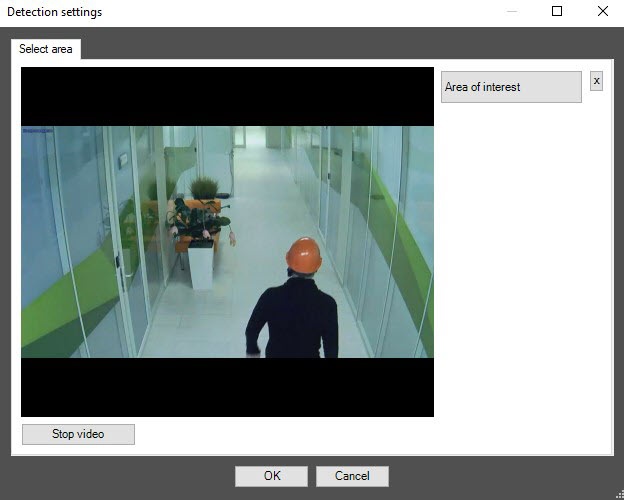
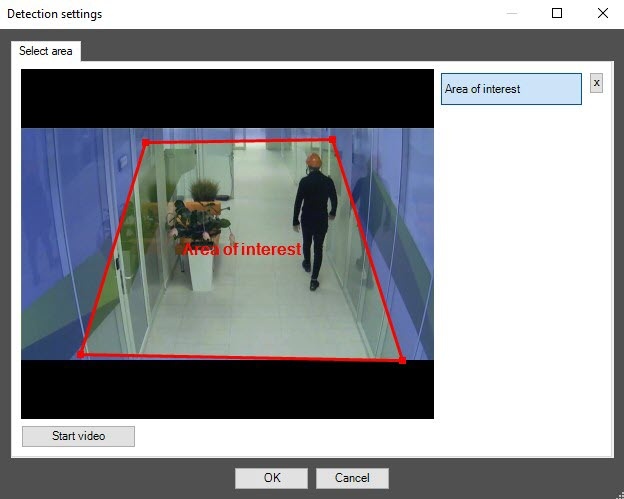
Note
 button to the right of the Area of interest button.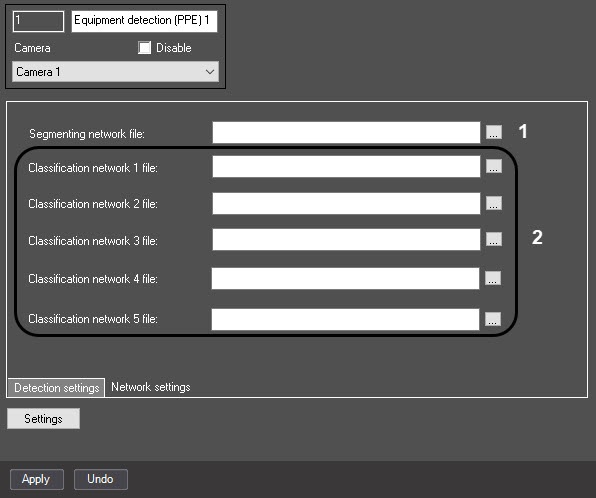
 button (1) to the right of the Segmenting network file field, and in the standard Windows Explorer window that opens, specify the path to its file. button to the right of the Classification network file field (2), and in the standard Windows Explorer window, specify the path to the custom neural network file. If there are several custom neural network files, specify the path to each.
Configuring the Equipment detection (PPE) module is complete.

