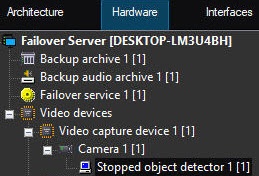
To configure the Stopped object detector program module, use the settings panel of the Stopped object detector object that is created on the basis of the Camera object on the Hardware tab of the System settings window.

To configure the stopped object detector, do the following:
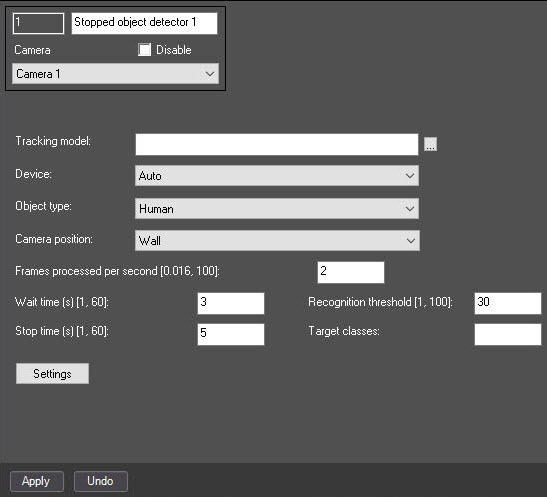
  1. Go to the settings panel of the Stopped object detector object.

  2. By default, the standard neural network according to the selected object type and device is initialized. You must not select manually standard networks for different processor types since it is performed automatically. If you have the unique neural network for use, click the  button to the right of the Tracking model field and specify its file in the standard Windows Explorer window that opens.

    To train the neural network, contact AxxonSoft technical support (see Data collection requirements for neural network training). The use of the trained neural network for a particular scene allows you to detect only objects of a certain type (for example, a person, a cyclist, a motorcyclist, and so on).

  3. From the Device drop-down list, select the one on which the neural network will operate: the CPU, one of the NVIDIA GPUs, or one of the Intel GPUs. Auto (default value)—device is selected automatically: The NVIDIA GPU takes the highest priority, then goes the Intel GPU, and then the CPU. Neural networks are selected by default depending on the selected device.
    • It may take several minutes to launch the algorithm on the Nvidia GPU after you apply the settings. You can use caching to speed up future launches (see Optimizing the operation of neural analytics on GPU).
    • If you select a processor other than the CPU, the selected device carries most of the computing load. However, the CPU is also used to run the detector.
  4. From the Object type drop-down list, select the object type:
  1. From the Camera position drop-down list, select:
    1. Wall—objects are detected only if their lower part is in the area of interest that is set in the detector settings.
    2. Ceiling—objects are detected even if their lower part isn't in the area of interest that is set in the detector settings.
  2. In the Wait time (s) [1, 60] field, specify the waiting time for the reappearance of the disappeared stopped object in seconds in the range [1, 60].
  3. In the Stop time (s) [1, 60] field, specify the time in seconds after which the object is considered stopped in the range [1, 60].
  4. In the Recognition threshold [1, 100] field, specify the minimal detection threshold in percent in the range [1, 100]. If the object recognition probability is lower than the specified one, the data is ignored. The higher the value, the higher the detection quality, but some events from the detector may not be considered.
  5. In the Target classes field, if necessary, specify the class of the detected object. If you want to display tracks of several classes, specify them separated by a comma with a space. For example, 110.
    The numerical values of classes for the embedded neural networks: 1—Human/Human (top-down view), 10—Vehicle.
    1. If you leave the field blank, the tracks of all available classes from the neural network are displayed (Object typeNeural network file).
    2. If you specify a class/classes from the neural network, the tracks of the specified class/classes are displayed (Object typeNeural network file).
    3. If you specify a class/classes from the neural network and a class/classes missing from the neural network, the tracks of a class/classes from the neural network are displayed (Object typeNeural network file).
    4. If you specify a class/classes missing from the neural network, the tracks of all available classes from the neural network are displayed (Object typeNeural network file).

  6. Click the Settings button to determine the area of interest and the ignore area.
  7. You can sequentially set the anchor points of the area of interest (highlighted by the red color) where the stopped objects are ignored.
  8. You can sequentially set the anchor points of the ignore area (highlighted by the yellow color) where the stopped objects are ignored.

    Click the Stop video button to pause playback and capture a frame of the image.
    To run the video, click the Run video button.

    To specify the area of interest or the ignore area, click the corresponding button. The button is highlighted by the blue color.

    There can be only one area of interest as well as the ignore area.

    To remove the area, click the button.

    If you don't specify the area of interest, the entire frame is analyzed.

  9. Click the OK button to save the specified areas, close the Detection settings window, and return to the detector settings panel.
  10. Click the Apply button to save the changes.

Configuring the Stopped object detector program module is complete.