
Go to documentation repository

Documentation for Axxon PSIM 2.0. Documentation for other versions of Axxon PSIM is available too.
Previous page Next page

This page describes how to set the parameters of the Monitor interface window:
- Screen coordinates and window size.
- Toolbar (displayed only in the List mode—see Configuration of the display mode of camera windows).
- The display of the number, name, time, menu, camera frame, and additional information in surveillance windows displayed on the video surveillance monitor.
- The ability to select cameras that you want to display in the surveillance window using the special menu in which cameras are grouped, and you can use a search.
- The ability to enable asynchronous hardware decoder NGP (GPU+CPU) to reduce CPU load.
The setup is performed in the following way:
- Go to the Basic settings tab on the settings panel of the Monitor object.
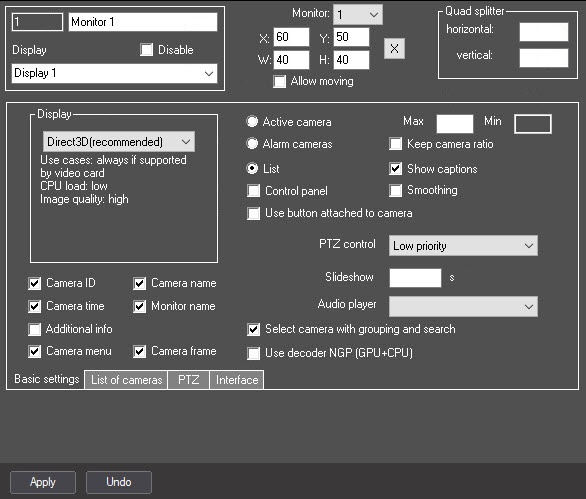
- From the Monitor drop-down list, select the monitor number in the operating system (computer monitor), the coordinates for which must be set further.
- Set the position of the Monitor window in one of the following ways:
- Manually:
Set the coordinates of the left upper corner of the Monitor window: the X (the horizontal indent from the left border of the image) and Y (the vertical indent from the upper border of the image) fields. Coordinates are expressed as a percentage relative to the screen size horizontally and vertically, respectively.
- Set the size of the Monitor window: the W (window width) and H (window height) fields. Dimensions are expressed as a percentage relative to the screen size horizontally and vertically, respectively.
To display the toolbar in the Monitor window, you must set the switch to the List position on the Basic settings tab and then set the Control panel checkbox.
Note
If the toolbar is enabled, the H window height is automatically equal to the W window width. You cannot set the width less than 20%. Such a setting is saved but isn't applied.
Note
By manually setting the coordinates, you can adjust the position of the Monitor window on several monitors at the same time. You can use it when setting up the video wall. For example, if you want to stretch one Monitor window to two computer monitors, you must set X=0, Y=0, W=200, H=100. If you want to stretch one Monitor window to four computer monitors, set X=0, Y=0, W=200, H=200.
Note that if there is one computer monitor and X and Y coordinates are greater than 100 or width and height are greater than 100, the Monitor window isn't displayed on this one monitor or is displayed incompletely.
Attention!
When you set up the video wall using Windows, note that the load on video cards to which the physical monitors for the video wall are connected is distributed unevenly, and you cannot regulate it by using Axxon PSIM.
For an even load on the CPU and GPU, you must set up the video wall with the NVIDIA® Mosaic™ technology using the NVIDIA® Quadro® Sync device (see NVIDIA documentation).
- Using the test window:
- Click the
 button.
 - Place the opened Specify dimensions test window in the position where the Monitor window must be displayed:
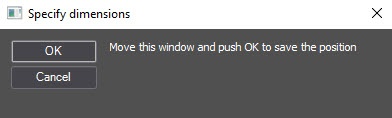
- Click the OK button. As a result, the coordinates in the X, Y, W, H fields are set according to the size and position of the test window.
- Click the
- Manually:
If you want to move the Monitor window, set the Allow moving checkbox.
Note
This setting is relevant only when you use the toolbar.In the horizontal and vertical fields of the Quad splitter group, set the number of surveillance windows that are displayed in the Video surveillance monitor window horizontally and vertically, respectively. If you don't set one of these values, the default grid of surveillance windows, depending on the selected layout, is displayed in the Video surveillance monitor window. The maximum number of surveillance windows vertically and horizontally is 64 and 64, respectively.
If you create several layouts, use the CycleByLayouts=1 parameter of the HKEY_LOCAL_MACHINE\SOFTWARE\AxxonSoft\PSIM\ registry section (see Registry keys reference guide) to enable the layouts slideshow.Note
Fields in the Quad splitter group are inactive if you select the Alarm cameras mode (see Configuration of the display mode of camera windows).
The quad splitter settings are ignored if the user is on the previously created layout.
If you want to save the ratio of the width and height of the video coming from the camera when it is displayed in the surveillance window, set the Keep camera ratio checkbox. If you set the checkbox, there can be an empty space in the surveillance window that isn't occupied by the video during the display. If you clear the checkbox, the video occupies all available space of the surveillance window, while the ratio can be affected.
Note
When you work with widescreen monitors, portrait-oriented monitors, or in other cases, it can be necessary to use other window proportions. For this, use the Monitor<monitor_id>_cw, monitor<monitor_id>_ch, monitor<monitor_id>_w43, monitor<monitor_id>_h43 registry keys (see Registry keys reference guide).
Set the Smoothing checkbox to display the video of great resolution on which the ladder effect appears when it is displayed in the small window.
Note
When you use the smoothing function, the load on the CPU of the computer where the video is displayed increases significantly (up to 30%). As a result, if the computer lacks the resources to use this function, the video display speed (FPS) can decrease, the response to telemetry commands slows down, and so on. Due to this, we recommend using this setting only for displaying video from analog cameras or the low-resolution video. The function affects only the video display in the video surveillance monitor. The original video stream from the camera comes to the archive and to detectors.
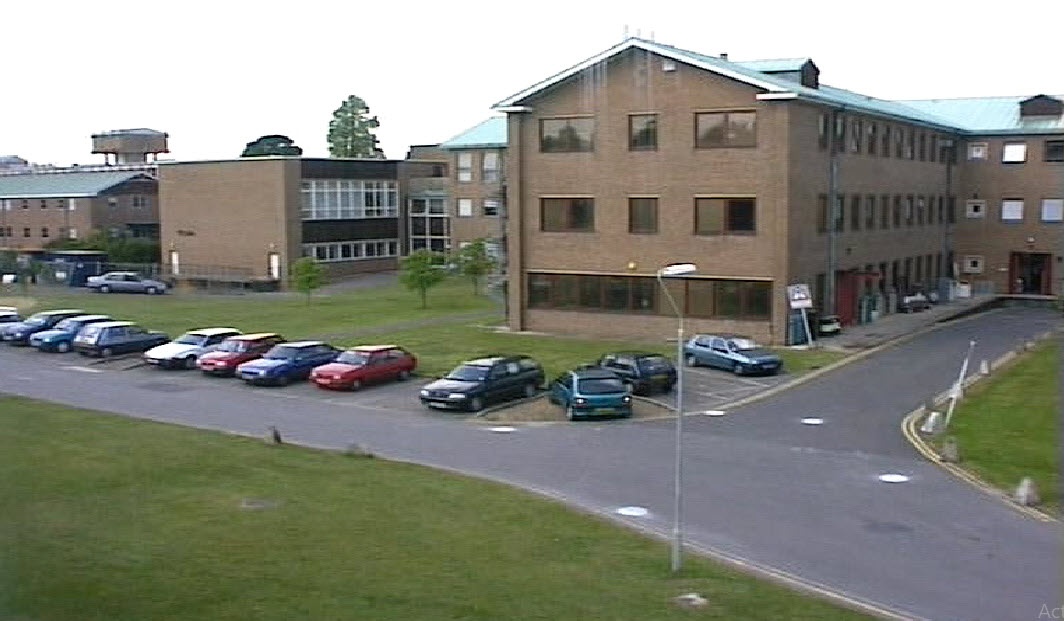
The example of the video image received with the smoothing function
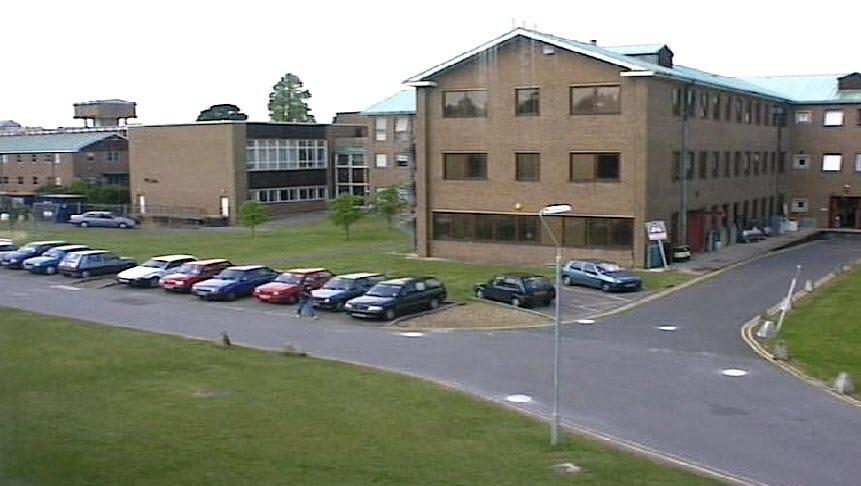
The example of the video image received without the smoothing function
By default, all elements of the surveillance window, such as number, name, time, menu, camera frame, and the name of the video surveillance monitor, are displayed except for the additional information (see Additional information on camera). To disable the display of these elements, clear the corresponding checkboxes in this group of settings.
Note
You can also enable the display of the date next to the camera time using the ShowDate registry key.
- In the surveillance window, you can switch between cameras using the Camera submenu (see Selecting camera to display in Surveillance window). Set the Select camera with grouping and search checkbox to group cameras in this menu by computers so that you can search among them.
- Set the Use decoder NGP (GPU+CPU) checkbox to enable the asynchronous hardware decoder NGP (GPU+CPU). Video decoding will be performed by the GPU, reducing the load on the CPU (for more information about the asynchronous hardware decoder, see Asynchronous hardware decoder NGP).
- To save the changes, click the Apply button.
Setting the parameters of the Monitor interface window is complete.
Overview
Content Tools