
Go to documentation repository

Documentation for Axxon PSIM 2.0. Documentation for other versions of Axxon PSIM is available too.
Previous page Next page

On the page:
Purpose
The video surveillance monitor for web browsers is used for remote video surveillance of protected facilities via a web browser and TCP/IP communication environment. Remote video surveillance via a web browser doesn't require installation of Axxon PSIM on the operator’s workstation (however, the browser used must support Java).
Functions
The video surveillance monitor for web browsers has the following functions:
- Remote video surveillance without the Axxon PSIM installation on the client.
- Change the number of surveillance windows on the video surveillance monitor via a web browser.
- Camera arming and disarming.
- Detector control.
- Video recording.
- Working with video archives.
- Control of PTZ devices.
Interface description
The following figure shows the interface of the video surveillance monitor via a web browser.
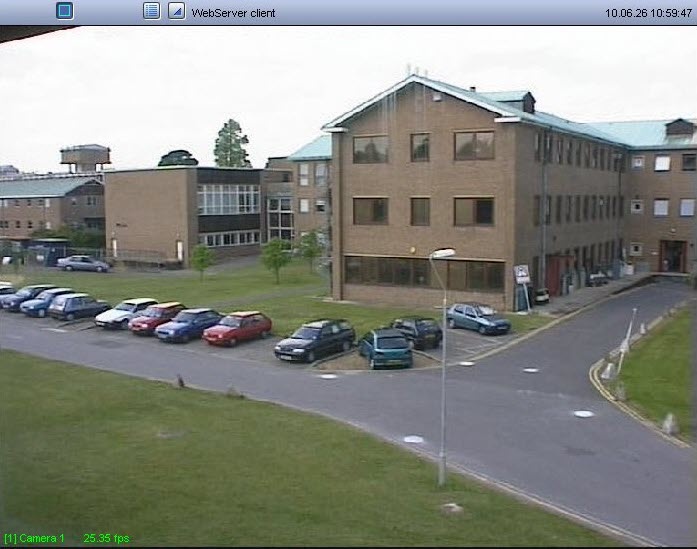
The video surveillance monitor via a web browser consists of a field for displaying surveillance windows and a toolbar containing the following elements:
- The
 buttons are used to change the number of displayed surveillance windows.
 - The
 button is used to select the layout.
 - The
 and
and  buttons are used to play back videos in the archive.
 - The
 field displays the current date and time.
Every surveillance window has the  function menu that is used to select a camera and to access some camera options. To open the menu, left-click the camera number in the surveillance window.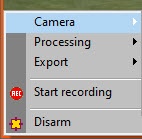
The color of the outline of the surveillance window and the color of the camera name indicate the camera status.
If there are any troubles with camera connection, there is an icon above the camera number. The icon indicates the existing trouble:
- No video signal

- No camera connection

| Name | Description |
|---|---|
| No video signal | Appears above the icon of the camera number when there is no video signal. This can happen if the camera isn't connected or if it is restarted. Note. If there is no video signal, the latest image is displayed in the surveillance window or a blue screen, depending on the type of video capture card |
| No camera connection | Appears if the incorrect type of video capture card is specified |
Overview
Content Tools