
Go to documentation repository
Documentation for Axxon One 3.0/3.1 version. Documentation for Axxon One 2.0 version is also available.

On the page:
General information
LDAP catalogs allow you to centralize the user management. Axxon One supports three operation scripts with LDAP:
- Manual registration of LDAP users: allows granting selective access to the LDAP catalog. The administrator manually creates the Axxon One user and links it with the LDAP account.
- Synchronization of LDAP users: allows adding users in bulk. The system loads users from the selected LDAP branch and automatically adds them to the selected Axxon One role.
- Automatic registration of LDAP users: allows any LDAP user to log in to Axxon One under one or multiple predetermined roles. After the system successfully checks the password, the user is automatically added to the configuration and gets the role specified in the Role for automatic registration of user field.
Configuration of the LDAP catalog
To configure the LDAP catalog, do the following:
- Go to the Configuration management tab → Users.
In the LDAP catalogs group, click the Create... button.
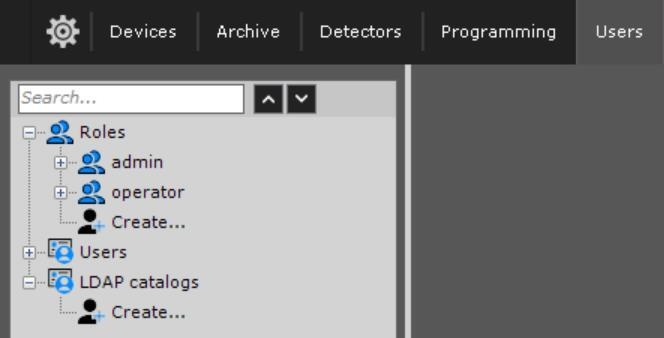
The LDAP 1 object is added to the system. On the right, the panel with connection settings to the LDAP 1 catalog is displayed.- Specify the LDAP catalog settings listed in the table:
Field Value Description LDAP connection Name LDAP 1 Enter the name of the catalog Server name or IP address ldap.postland.org Enter the address of the LDAP catalog server Port 636 Enter the connection port of the LDAP catalog server
Attention!
The following ports can be used for connection as well:
- 3268
- 3269 (for secure connection)
Use secure connection (SSL) 
Set the checkbox if you want to use a secure connection (SSL) when you connect to the LDAP catalog 
Base DN ou=Address,dc=company,dc=domain Enter the Distinguished Name of the branch from which the data search starts
Attention!
- If LDAP users are located in multiple directories with the hierarchical structure, you cannot synchronize all users at the same time.
- To synchronize each user group in the DN branch, you must specify the path to the corresponding directory.
For example, LDAP contains the Employees directory and the Managers, Cashiers and Salesmen subdirectories:- DN branches for synchronizing users within the Managers directory: ou=Managers,ou=Employees,dc=example,dc=com.
- DN branches for synchronizing users within the Cashiers directory: ou=Cashiers,ou=Employees,dc=example,dc=com.
- DN branches for synchronizing users within the Salesmen directory: ou=Salesmen,ou=Employees,dc=example,dc=com.
User uid=your.login,ou=Users,dc=company,dc=domain Enter the name of the user who has the read access from the base DN in the LDAP (RDN + DN) format Password Enter the user password Filter settings Search mode Users Select the search mode in the catalog Groups Users in Groups Users and Users in Groups Search filter (objectClass=person) Enter a filter string of entries in the catalog
Attention!
To upload users by groups, not by catalogs, you must use the memberof attribute in the filter. For example:
(&(objectClass=user)(memberof=CN=YourGroup,OU=Users,DC=YourDomain,DC=com))
Group search filter (objectClass=group) Enter a filter string of entries in the group
Attention!
The Search filter and Group search filter fields are mutually exclusive and are activated depending on the value in the Search mode field:
- Users—only the Search filter field is active.
- Groups—only the Group search filter field is active.
- Users in Groups and Users and Users in Groups—both fields are active.
LDAP templates OpenLDAP Select a template to set the username attribute Microsoft Active Directory Username attribute cn Enter the attribute from which the username is obtained. To search for users via the sAMAccountName attribute, you must enter the attribute in lowercase letters—samaccountname. DN attribute entrydn Enter the attribute from which the user's DN is obtained.
The default value of the DN attribute depends on the selected LDAP template:
- For the OpenLDAP template, the value entrydn is used.
- For the Microsoft Active Directory template, the value distinguishedname is used
Role for automatic registration of user Select a role to which new users of the LDAP catalog are automatically added when they log in to Axxon One. If you don't specify a role, the automatic user creation for this catalog is disabled - Click the Apply
 button.
As a result, the LDAP catalog is added to the system.
To test the connection, click the Test connection  button. If the connection isn't successful, an error message appears.
To upload the catalog users, click the Load  button. If the connection is successful, the form below is filled with user data. Otherwise, an error message appears.
Configuring LDAP directory group synchronization
LDAP directory group synchronization is used to automatically match LDAP user groups with system roles. To configure LDAP group synchronization:
- In the Filter settings panel, in the Search mode field, select Groups. The Configuring LDAP directory group synchronization panel opens on the right.
- Click the Load button.
- In the Configuring LDAP directory group synchronization panel:
- In the Group field, enter the name of the group.
- In the Distinguished Name (DN) field, select the necessary attribute from the list.
- In the Roles field, set the checkboxes next to the required roles to which new users will be automatically added.
- Click the Add
 button.
- Click the Apply button to save the changes.
Configuration of the LDAP directory group synchronization is complete.
Synchronization of the LDAP catalog
Synchronization can be performed manually or automatically. To synchronize LDAP catalogs:
- On the Users tab, click the LDAP catalogs group.
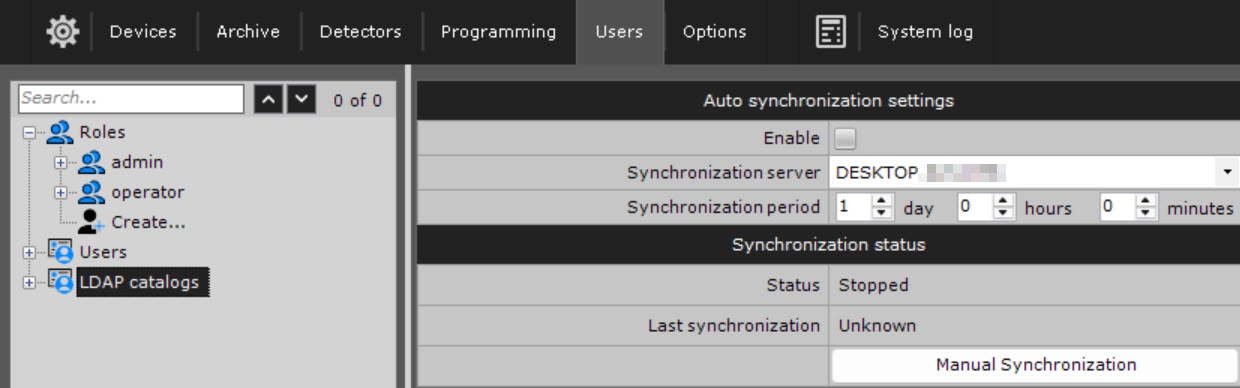
- Specify the synchronization parameters listed in the table:
Parameter Value Description Auto synchronization settings Enable 
By default, automatic synchronization is disabled. To enable automatic synchronization, set the checkbox 
Synchronization server Select the synchronization server from the drop-down list Synchronization period 1 day 0 hours 0 minutes Set the period for automatic synchronization Synchronization status Status Stopped By default, the synchronization status is Stopped. Once synchronization starts, the status changes Last synchronization Unknown By default, the date of the last synchronization is displayed as Unknown. Once synchronization starts, the date and time of the last synchronization are displayed - Click the Apply button.
- To start manual synchronization, click the Manual Synchronization button.
Configuration of synchronization is complete.
Copy the LDAP catalog
To copy a catalog with all current settings saved:
- Click the name of the catalog that you want to copy.
- Click the Create button.
As a result, the new catalog with identical settings is created. The default name of the new catalog is LDAP 1, LDAP 2, and so on, depending on the number of previously created catalogs.
Remove the LDAP catalog
To remove a catalog:
- Click the name of the catalog that you want to remove.
- Click the Remove
 button.
As a result, the selected catalog is removed.
Overview
Content Tools