...
Configuration of the Equipment detection (PPE) module includes: general detector settings of the detector, selection of the area of interest, and neural network configuration of the neural networks.
The You can conigure the Equipment detection (PPE) module is configured module on the settings panel of the Equipment detection (PPE) object that is created on the basis of the the Camera object on the Hardware tab of the System settings window.
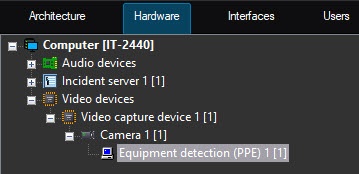
General detector settings
...
General configuration of the detector is performed on the Detection settings tab on the settings panel of the Equipment detection (PPE) object.
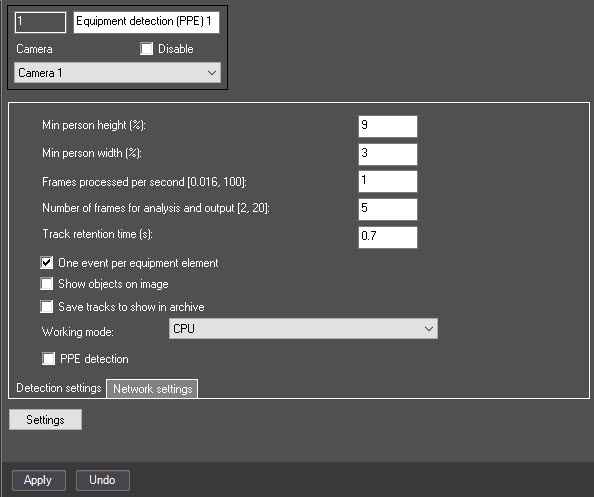
- In the Min person height (%) and Min person width (%) fields fields, enter the minimum height and width of a person in the frame as a percentage of the frame height/width. Objects smaller whose size is lower than the specified size will not be one aren't detected.
- In the Frames processed per second [0.016, 100] field, set specify the number of frames per second that will be processed by the detector processes.
In the Number of frames for analysis and output [2, 20] field, enter specify the minimum number of frames on which the detector must detect a violation must be detected in order to generate an event. The value must be so that an event is generated in the range [from 2 ; to 20].
- In the Track retention time (s) field, enter specify the time in seconds in the range from 0.3 to 1000 after which the object track is considered lost. You can use this parameter in situations when one object in the frame temporarily overlaps another.
By default, the One event per equipment element checkbox is set, and the detector generates an event once for each equipment element violation within an one object (track). If you want the detector to generate an event each time an the equipment violation occurs, clear the checkbox.
| Info |
|---|
|
Example. A person appeared in the a frame without a helmet, then put it on and then took it off again. If the One event per equipment element checkbox is set, then there is one event, if not—two not, two events. |
- Set the Show objects on image checkbox if it is necessary you want to outline the detected object with a border on the an image in the the Monitor interface object window.
Set the Save tracks to show in archive checkbox to save the object (track) to the archive.
| Info |
|---|
|
The frame on the image of the detected object is saved in the Monitor object archive. |
From the Working mode drop-down list, select the device on which the neural network will operateoperates: CPU, one of NVIDIA GPUs, or one of Intel GPUs. The default value is CPU. Depending on the selected device that you select, the neural networks will be are selected by default.
| Note |
|---|
|
- It can take several minutes to launch the algorithm on
- an NVIDIA GPU after you apply the settings. You can use caching to speed up future launches (see Optimizing the operation of neural analytics on GPU in Windows OS).
If you
specify another processing resource than select a processor different from the CPU,
this device will carry most then the main part of the
computing load. However, the CPU will also be used to run the detector. |
computational load is performed on the selected device. The CPU is also used for detector operation. In the Detector Pack subsystem of version 2.0, the support of Intel HDDL is removed, therefore, when you update from version 1.0, the Not supported option is selected automatically instead of this device variant, and detectors don't operate. To resume the detector operation, select the required device from the list.
|
- Set the PPE detection checkbox to detect the presence of personal protective equipment (PPE). By default, the checkbox is clearcleared.
Selecting the area of interest
Click the Settings button. The Detection settings window opens.
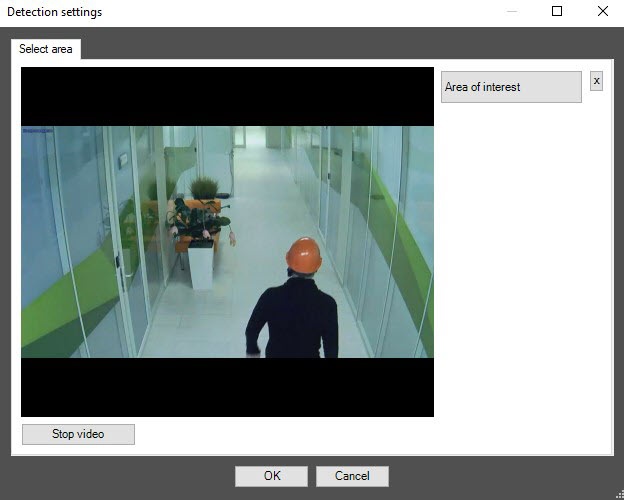
- Click In the Detection settings window, click the Stop video button to pause playback and capture a frame of the video image.
- Click the Area of interest button to specify the detection area of detection. The button is highlighted in blue.
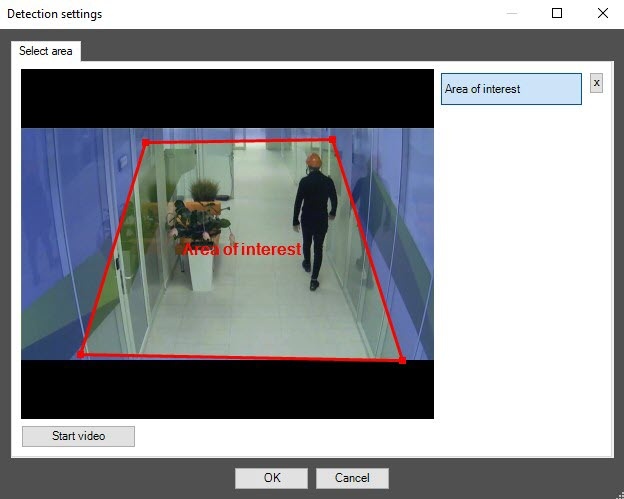
- On the captured video frame, sequentially set the anchor points of the area in which the objects will be detected by left-clicking are detected using the mouse button. The rest of the frame will be is faded. If you don't specify the area of interest, the entire frame is analyzed.
| Info |
|---|
|
- You can add only one area. If you try to add a second area, the first area is deleted.
- To delete
the - an area, click the
 Image Modified button to the right of the Area of interest button. Image Modified button to the right of the Area of interest button.
|
There can be only one area of interest. - Click the OK button to close the Detection settings window and return to the detector settings panel of the detector.
Configuring neural networks
- Go to the Network settings tab on the settings panel of the equipment detector.
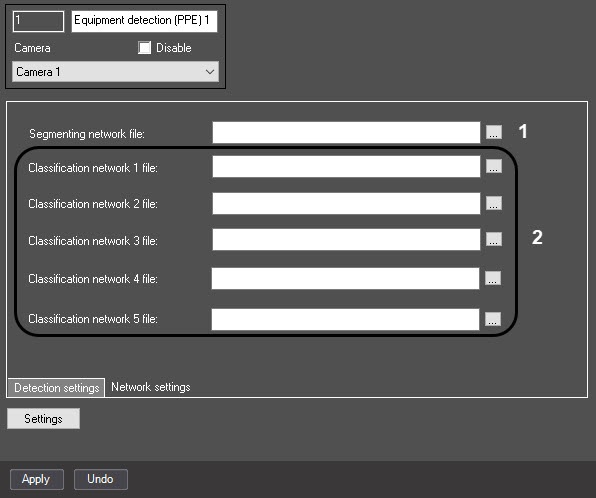
- By default, the standard (default) segmenting neural network is initialized according to the device selected in the Working mode drop-down list. The standard step 7 of the general settings section. Standard neural networks for different processor types are selected automatically. If you use a custom segmenting neural network, click the
 button (1) to the right of the Segmenting network file field, and in the standard Windows Explorer window that opens, specify the path to the its file.
 - By default, two standard classification neural networks are initialized: classification neural network (head PPE on the head) and classification neural network (body PPE on the body) according , according to the device selected processing device in the Working mode drop-down liststep 7 of the general settings section. Each classification neural network detects equipment on a specific body segment. The standard Standard classification neural networks for different processor types are selected automatically. If you want to detect only one item of equipment, click the button to the right of the Classification network file field (2), and in the standard Windows Explorer window, specify the path to the custom neural network file. If there are several custom neural network files, specify the path to each.
- Click the Apply button to save the settings.
The Configuring the Equipment detection (PPE)module is now configuredcomplete.