
Go to documentation repository


On the page:
General information
Export is the process of saving and transferring recorded videos and frames from Axxon One for later use. Export allows users to extract important moments related to security, monitoring, or event analysis. Export is available for users with the appropriate access level settings (see General information about users). If the client is connected to multiple domains, the export is available for cameras of those domains in which the current user has the appropriate permissions.
Attention!
When you export a video or frame for the first time, the export window opens in the minimal mode and uses the default settings:
- Video codec with the Default value,
- Compression level with the Default value,
- Frames per second with the Original frame rate value,
- Add event source titles with the No value (the checkbox is clear),
- Hide detected objects with the Don't hide value,
- Main titles overlay method with the Soft titles value,
- Event source titles overlay method with the Soft titles value.
If you change the default settings, you must re-encode the video image, which increases the CPU load and takes considerable time.
During the next export, the configuration dialog window is displayed. This window stores the previously selected settings.
Export of frames from live mode
To export frames from the live mode:
- Open the required layout (see Configuring layouts).
- Click the
 button in the surveillance window.
 - In the window that opens, specify the settings of the export parameters tnat are listed in the table:
Parameter Value Description Export Comment If necessary, enter a comment. It is displayed on the exported frame as titles Text overlay parameters Main titles Timestamp 
By default, a timestamp is displayed on the exported frame (the checkbox is set). If you don't need to display a timestamp, clear the checkbox
Attention!
The formats of event timestamp in the file name correspond to the specified settings in Windows OS.

Camera short name By default, the camera short name isn't displayed (the checkbox is cleared). To display the camera short name on the exported frame, set the checkbox Camera name
By default, the camera name isn't displayed (the checkbox is cleared). To display the camera name on the exported frame, set the checkbox Camera coordinates By default, camera coordinates aren't displayed (the checkbox is clear). To display camera coordinates on the exported frame, set the checkbox Username By default, the username isn't displayed (the checkbox is cleared). To display the username on the exported frame, set the checkbox Font Arial,16 Select the required font, style, size, look, and set of characters from the drop-down list Font color Black By default, the black color is set. If you want to change the color, click the color rectangle and select a color from the palette Overlay method Hard titles Embedded image-based titles. You cannot disable them when playing a video. The option is set by default (non-editable field) File type JPG Select the required file type from the drop-down list
Attention!
You can print the file immediately.
PDF Password If you need to export a frame to the encrypted ZIP archive, specify the archive password
Attention!
You must specify a password if you set the No value in the Allow unprotected export parameter (see Roles).
Export folder C:\Users\Documents\AxxonSoft\Export Select a folder to which you want to export a frame
Note
By default, the export is performed to the folder specified during the export setup. If you change the folder, the new path for the exported data is saved until the client is restarted.
- Click the Export
 button.
Note
You can perform quick frame export using the CTRL+S key combination (see Hot keys).
Frame export is complete.
Export of videos and frames from the archive mode
Attention!
- If a camera is located on the current layout, the last selected archive is exported.
- If a camera is on a different layout or isn't bound to a layout, the default archive is exported.
- If a camera records to multiple archives, the archive selected in the camera cell during playback in the layout is exported. The archive selection is saved when you exit the archive mode and switch to a different layout.
- If the selected cameras don't record to the archive, videos and frames from them aren't exported.
You can export a frame or video in the archive mode in two ways:
- By using the timeline. To do this:
- Open the required layout (see Configuring layouts).
- Switch to the archive mode (see Switching to the Archive mode).
- Click the Timeline panel button.
- Place the timeline pointer at the beginning of the interval.
- Click the Set beginning of period
 button.
 - Scroll the timeline and place the pointer at the end of the interval.
- Click the Set end of period
 button.
- Click the Actions with archive
 button.
 - In the window that opens, click the Export archive item.
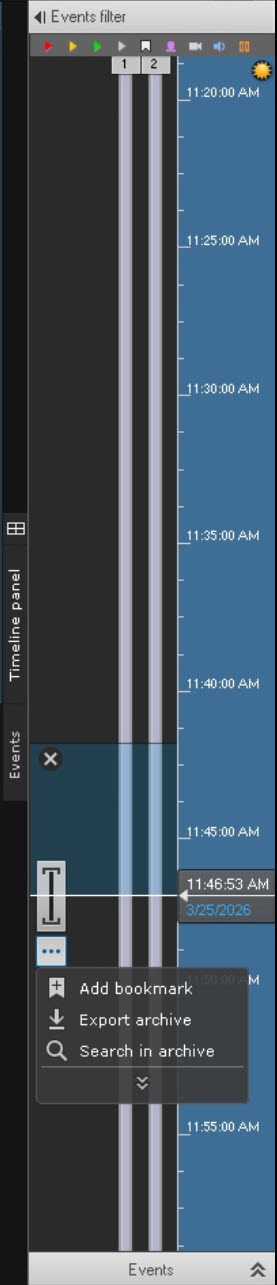
- In the Export window that opens, set the settings of the parameters specified in the table:
Parameter Value Description Export From [date], [month], [year], [hours], [minutes], [seconds] Specify the date and time interval for the exported video or frame
Note
- The date and time formats of the event in the file name correspond to the Windows OS settings.
- If video surveillance is performed in live mode, the frame that was at the moment when you clicked the button is exported. In this case, the From and To parameters aren't displayed.
- When you change the time range in the timeline or in the advanced navigation panel, the date and time values are updated automatically in the opened dialog window.
- When you hover the mouse pointer over the selected fragment, the Selected period pop-up window displays the From and To parameters of the period.
To Selected cameras [Camera short name].[Camera name] Select one or several cameras of the current layout. You can also add cameras from a different layout
Attention!
- If you select one camera when you open the export window, you cannot deselect it.
- If you select several cameras, there are no restrictions on deselection.
- If you don't select any cameras, the Export button is inactive.
- To select all cameras of the current layout, click the All from the current layout button.
Comment If necessary, enter a comment. It is displayed on the frame or when you play the exported video as titles Text overlay parameters Main titles Timestamp By default, a timestamp is displayed on the exported video or frame (the checkbox is set). If you don't need to display a timestamp, clear the checkbox
Camera short name By default, the camera short name isn't displayed (the checkbox is clear). To display the camera short name on the exported video or frame, set the checkbox Camera name
By default, the camera name isn't displayed (the checkbox is clear). To display the camera name on the exported video or frame, set the checkbox Camera coordinates By default, camera coordinates aren't displayed (the checkbox is clear). To display camera coordinates on the exported video or frame, set the checkbox Username By default, the username isn't displayed (the checkbox is cleared). To display the username on the exported video or frame, set the checkbox Bookmark By default, the bookmark isn't displayed on the exported video or frame (the checkbox is clear). To display a bookmark, set the checkbox
Attention!
You can set the value only in the archive or archive analysis mode. Export from the live mode is unavailable.
Font Arial,16 Select the required font, style, size, look, and set of characters from the drop-down list Font color Black By default, the black color is set. If you want to change the color, click the color rectangle and select a color from the palette Overlay method Select the overlay method from the drop-down list Soft titles The value is set by default. Text titles in the exported video are displayed as the embedded track for MKV, MP4, EXE formats or as the external SRT file for the AVI format. You can disable them when playing a video Hard titles Embedded image-based titles. You cannot disable them when playing a video Event source titles Add event source titles If a camera is connected to POS devices to receive data, you can export it. By default, the checkbox is set. If you don't want to display event source titles, clear the checkbox Overlay method Select the titles overlay method from the drop-down list Soft titles The value is set by default. Text titles in the exported video are displayed as the embedded track for MKV, MP4, EXE formats or as the external SRT file for the AVI format. You can disable them when playing a video Hard titles Embedded image-based titles. You cannot disable them when playing a video File type Select the file format for the exported video or frame from the drop-down list MKV Export of videos in the MKV format is performed without recompression JPG - Limited advanced settings functions.
- If you select only one camera, you can immediately print a file.
- The Export as single file checkbox is unavailable.
When you export in the PDF format, the settings from the domain options are used (see Export template). The date, time, and comment overlay a frame regardless of the main titles. If you add main titles, they are repeated on the exported frame
Attention!
Frames are exported only from cameras with archive recording. If a camera has no archive recording, a frame isn't exported regardless of the camera position on the layout.
PDF MP4 Export of videos in the AVI or MP4 format is performed with recompression by the codec selected in the settings. Due to the recompression, the export can take much longer than other formats. Also, it increases the load on the CPU, especially when you export several files at a time
Attention!
Exported videos in the MP4 format with the MJPEG codec aren't supported in the MPC-HC player.
AVI EXE When you export videos in the EXE format, the compilation of the executable file is performed. The executable file contains a video, the tools for its playback, and necessary codecs. When you export in the EXE format, take into account the Windows OS limitation due to which you cannot run executable files larger than 4 GB. When you export videos from a fisheye camera, the entire panoramic view, which you can rotate to the required viewing angle in the player, is exported
Attention!
If you export videos from a fisheye camera in the MKV, MP4, or AVI formats, the selected area on a camera in the layout interface is exported.
Export as single file If you select several cameras for the MKV, MP4, AVI, EXE formats, you can export to a single file Format settings Video quality Video codec Select the required format of the video codec from the drop-down list Default When you export a video, the source codec that was used during the initial recording to the archive is saved MPEG4 It provides good image quality at a relatively low bit rate. It is widely used for videos and video stream MJPEG It is a sequence of JPEG images that are transmitted as a video stream. Each frame is encoded separately. It has a large file size compared to other codecs, which leads to high network bandwidth requirements
Attention!
Exported videos in the MP4 format with the MJPEG codec aren't supported in the MPC-HC player.
h264 It provides high image quality at a relatively small file size compared to MPEG4 and MJPEG Compression level Select the required compression level for the exported video from the drop-down list Default When you export a video, the source compression level that was used during the initial recording to the archive is saved Minimum level The higher the compression level, the lower the detailing and image quality, which reduces the amount of data during transmission and storage Low level Medium/Low Medium level Medium/High High level Maximum level Video resolution Select the required video resolution from the drop-down list Original The default value. When you export a video, its original resolution is preserved. The video isn't re-encoded 320×240 (4:3 240p) - If the selected resolution exceeds the original in both height and width, the export is performed as Original.
- If the selected resolution exceeds the original on only one side, the video is resized to fit within the specified boundaries while maintaining the aspect ratio. Example:
- 1280х680 → 1280х720=1280х680
- 3840×2160 (4K UHD 2160p) → 1024х768 (4:3 XGA)=1024x576
426×240 (16:9 240p) 640×360 (16:9 360p) 640×480 (4:3 480p) 854×480 (16:9 480p) 1024×768 (4:3 XGA) 1280×720 (HD 720p) 1920×1080 (Full HD 1080p) 2560×1440 (2K QHD 1440p) 3840×2160 (4K UHD 2160p) Frames per second Select the required frame rate from the drop-down list Original frame rate The value is set by default. When you export a video, its original frame rate is saved, providing the maximum quality and accuracy of playback
Attention!
If you change the default settings, the Frames skipping, fps parameter becomes unavailable.
1/2 The frame rate of the exported video is two times lower than the original one 1/4 The frame rate of the exported video is four times lower than the original one 1/8 The frame rate of the exported video is eight times lower than the original one Video special options Add player By default, Axxon Player isn't exported with a video (the checkbox is clear). To play back the exported video in Axxon Player, set the checkbox 
Export audio By default, a video is exported without audio (the checkbox is clear). To export a video with audio, set the checkboxAttention!
A video is exported without audio if you set the No access value in the Microphone access parameter (see Roles)
Maximum file size, MB 4000 Set the maximum file size of the exported video in megabytes. When you reach the specified size, a new file is created. There are no restrictions on the file size Frames skipping, fps 0 Set the required value of the FPS skipping per second. The value must be in the range [0, 300] Video speed 0 If you need to change the speed of the exported video, set the speed rate. The value must be in the range [0, 128] Highlight areas Add video analytics tracks If you want to display the tracks of objects detected by the detector, select a camera from the drop-down list Add bookmark markers If you want to display the selected area on the exported video or frame, set the checkbox. By default, the checkbox is clear
Attention!
- You can set this value only in the archive or archive analysis mode. Export from the live mode is unavailable.
Confidentiality of objects Hide detected objects Select the required value from the drop-down list Don't hide If you don't need to hide the masked area in the exported video or frame Hide If you need to mask objects in the exported video or frame Invert and hide If you need to mask the area around objects
Note
When you select the Hide or the Invert and hide value, the export process can take a long time, regardless of the format. This is due to the necessity of video reencoding for face masking, which requires additional computational resources and time.
Password If you need to export a frame or video to the encrypted ZIP archive, set the archive password
Attention!
You must specify a password if you set the No value in the Allow unprotected export parameter (see Roles).
Export folder C:\Users\Documents\AxxonSoft\Export
Select a folder to which you want to export a video or frame
Note
By default, the export is performed to the folder specified during the export setup. If you change the folder, the new path for the exported data is saved until the client is restarted.
- Click the Export button.
- From the surveillance window in the archive mode. To do this, do the following:
- Open the required layout (see Configuring layouts).
- Switch to the archive mode (see Switching to the Archive mode).
- Click the required camera.
- Place the pointer at the beginning of the interval in the surveillance window.
- Click the
 button.
 - Using the left mouse button, scroll the video to the right to the required moment.
- Click the
 button.
- In the upper right corner of the surveillance window, click the
 button.
 - In the Export window that opens, set the settings of the parameters specified in the table.
- Click the Export button.
Export of a video or frame is complete.
Attention!
- The watermark is added to the exported frames and videos. You can check the watermark in the Watermark checker utility.
- SHA-256 cryptographic algorithm is used as a watermark for the exported data.
Quick export
You can perform quick export from the live mode (see Switching to Live mode) or archive mode (see Switching to the Archive mode). To do this, do the following:
Attention!
- When you use quick export, the settings from Quick export parameters are used.
- The Bookmark and Add bookmark markers parameters are only available in the archive mode (see Switching to the Archive mode).
- Select the required layout on the layout panel.
- Left-click the required camera cell.
- Right-click the Export the current video frame button or use the CTRL+S key combination (see Hot keys).
Quick frame export is complete.
Frame print
You can print a frame for JPG and PDF formats from the live or archive mode.
The Print button is available only if you select one camera. If you select multiple cameras, the button becomes unavailable.
After you click the Print button, the preview window where the file for export is displayed opens (see Export template).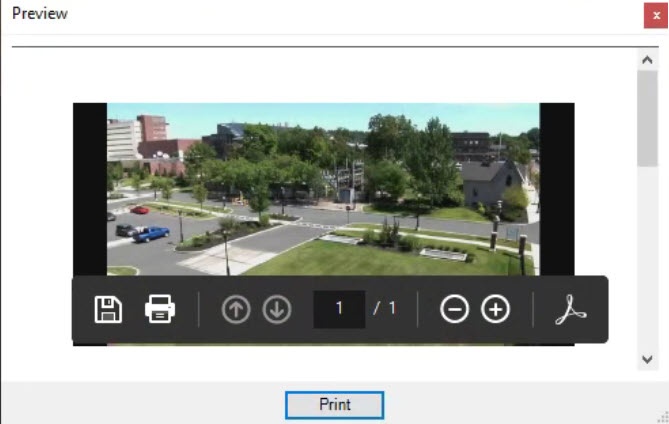
Simultaneous export of all incident recordings
Using the story board (see Story board), you can simultaneously export all found incident videos from the archives of different cameras by collecting them in the story board beforehand.
To do this:
- Open the required layout (see Configuring layouts).
- Switch to the archive mode (see Switching to the Archive mode).
- Select the required camera.
- Place the timeline pointer at the beginning of the interval.
- Click the button.
- Scroll the timeline and place the pointer at the end of the interval.
- Click the button.
- Click the Story board button.
- In the board that opens, click the
 button in the center of the preview. The video is added to the export kit.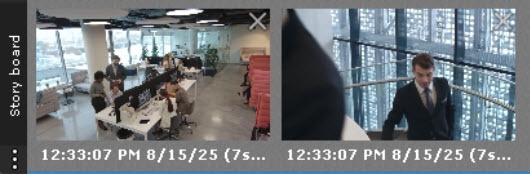
- Repeat the above steps for all intervals of interest with required cameras.
- Click the
 button to export all selected videos.
 - In the Export window that opens, set the settings of the parameters specified in the table.
- Click the Export button.
By default, video is exported to a single file. To export video from different cameras to separate files, clear the Export as single file checkbox in the export window.
Note
When you export to a single file, streams are recorded in parallel. For playback, use a player with the ability of playing several video streams at a time (for example, VLC).
Export of videos of the selected incidents is complete.
Set the export area and privacy mask
In the archive or archive analysis mode, you can simultaneously set the export area and privacy mask.
Attention!
When you export a video/frame with the specified export area or the privacy mask, the process of recompression occurs. As a result, the time export can be increased.
Export area
Setting the export area allows exporting only the required part of the frame.
To set the export area, do the following:
- Open the required layout (see Configuring layouts).
- Switch to the archive mode (see Switching to the Archive mode).
- Click the
 button in the surveillance window.
A rectangular area with four anchor points is displayed.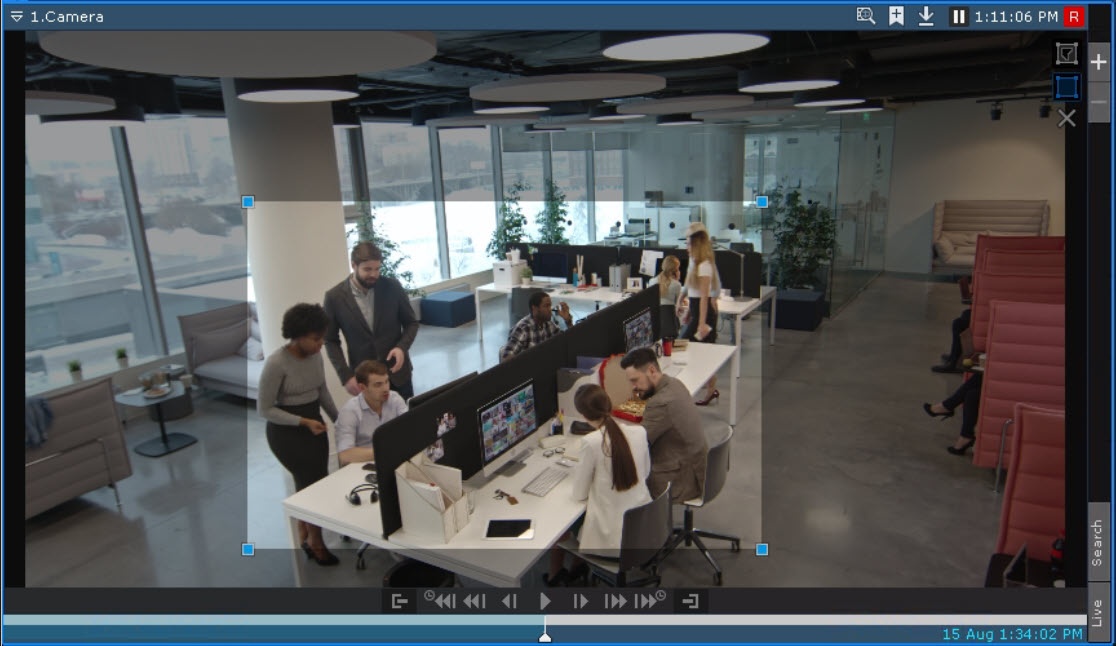
- You can set the required export area by moving anchor points. To do this, left-click the point, and while holding it down, move the mouse pointer.
Setting the export area is complete.
Privacy mask
Setting a privacy mask allows hiding the predetermined areas of the frame in the exported file. You can set the unlimited number of privacy masks.
To do this, do the following:
- Click the
 button in the surveillance window.
 - Indicate the closed privacy mask area by adding anchor points. To add an anchor point, left-click the video image. The number of anchor points is unlimited. You can also:
- Delete an anchor point by right-clicking.
- Delete a privacy mask by clicking the
 button.
 - Add a new privacy mask.
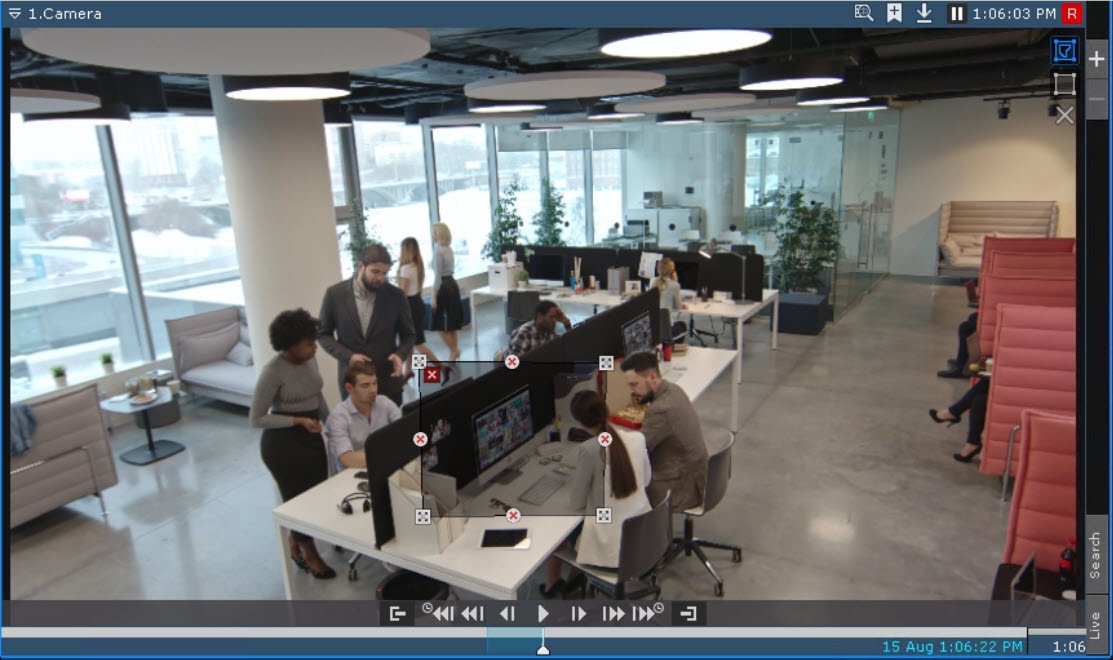
Setting a privacy mask is complete. The privacy mask is blurred on the exported frame or video.
Display of the export status
After you start the export process, the status is displayed on the export panel located below the Axxon One settings panel. This panel is visible from the moment you start exporting until you close all notifications.
To complete the export process, click the Finish button. The duration of the exported file can be longer than specified because the key frame doesn't always occur at the beginning of the export interval. To cancel export, click the Cancel button. In this case, the file isn't saved.
If you start multiple export processes, you can switch between them by using the 
 buttons. The following information is displayed between them:
- sequence number of the current export operation;
- total number of export operations;
- export progress for each operation.
After you complete the export, you can click the Open folder button on the notification panel to view the exported video or frame.
To close the export status message, click the  button.
Attention!
- You cannot close the message if the export is active.
- At high CPU load, the export sessions are terminated. After you decrease the load on the CPU, the export option is automatically resumed.
If any error occurs during export, it is displayed on the error panel (see Control in Live Video mode).
Playback of exported videos in Movies and TV app
Due to the lack of G.711 and G.726 codec support in Windows 10's "Movies and TV" app, the app does not play audio in exported video.
You can use alternative video viewer applications to obtain the full playback.
Playback of exported videos in Telegram app on iOS devices
Videos exported in MPEG4 format cannot be played back on iOS devices due to peculiarities of the Telegram app. We recommend exporting videos in other formats to play them correctly in the Telegram app on iOS devices.
Reset of the export settings after you update from Axxon Next 4.5.10 to Axxon One 2.0.2 and higher
After you update from Axxon Next 4.5.10 to Axxon One 2.0.2 and higher, the settings of the PDF template and Watermark settings in the Options section → Export template are reset. You must reconfigure them.
Overview
Content Tools