
Go to documentation repository


In Axxon PSIM, audio signals are written to the local disks of the server, network disks, and USB disks.
Audio files created in the synchronous audio and video recording mode are stored together with videos in the VIDEO folder(s). Thus, selecting disks for storing audio recordings that are created synchronously with video recordings is equivalent to selecting disks for storing video recordings. This procedure is described in the relevant section of this documentation (see Select disks for video archive storage). Audio files created using audio triggers are stored in the AUDIO folder separately from the video recording archive.
By default, the server's hard disk isn't specified for storing audio recordings created using audio triggers, so recording on audio triggers isn't possible.
Attention!
If audio is recorded on an audio trigger and not in the synchronous audio and video recording mode, then the disks you selected for recording audio must be different from those you selected for recording video.
Note
We recommend using disks with the NTFS file system for storing the archive. If you use the FAT32 file system, there can be problems caused by this system, particularly the lack of logging.
You can select disk(s) for archive storage in one of the following ways:
- Estimate the disk capacity necessary for storing audio created on audio triggers. The estimation method is similar to the method for estimating the amount of disk space required for recording a video archive (see Free disk space (video archive size) required).
- Go to the settings panel of the Computer object.

- The local disk names, available for audio archiving, are listed in the Disk column of the Archive disks table (1). The GB column contains the relevant disks' capacities in gigabytes (GB). Select the disks for audio archiving and make sure that the total selected disk capacity is sufficient.
- Set the checkboxes in the Audio column (2) next to the selected disks. Local, network, and USB disks are available for storage.
- To add a network disk via UNC paths, do the following:
- Go to the last line in the disk list and click the down key.
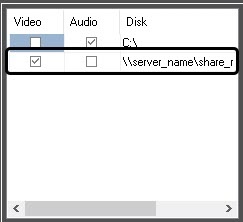
- In the Disk column, enter a path to a network disk in the line. The UNC path is set in the format \\server_name\share_name, where server_name is the name of the file server and share_name is the network name of the general folder.
- Set a checkbox in the Video column for the created disk.
- Go to the last line in the disk list and click the down key.
- Click the Apply button.
Selecting the disks for audio archive storage is complete.
Overview
Content Tools