
Go to documentation repository

Documentation for Axxon PSIM 2.0. Documentation for other versions of Axxon PSIM is available too.
Previous page Next page

This page describes the setting on the example of receiving a video from Axxon One.
You can configure video receiving via the ONVIF-Server module in Axxon One using standard tools. For information on how to search and add IP devices in Axxon One, refer to Axxon One User Guide.
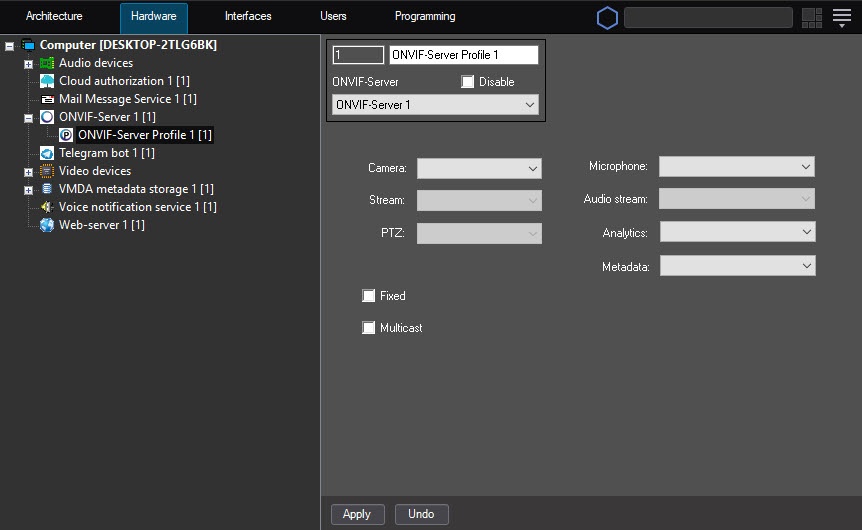
After you add a camera in Axxon One, two ONVIF-Server Profile objects on each camera added to the bound RTSP Server are created on the basis of the ONVIF-Server object in Axxon PSIM. These objects correspond to the video streams of low and high quality in Axxon One.
Note
If multistreaming is disabled for a camera, then the parameters of both profiles corresponding to that camera are the same. See Configuring the multistream video.
If you configure user permissions in Axxon PSIM (see Configuration of users and rights), then specify the Axxon PSIM username and password to connect to a camera. Otherwise, there is no need to specify the username and password.
If necessary, you can select the required video stream from the Stream drop-down list. You can configure available camera video streams on the settings panel of the Camera object, see Configuring the multistream video.
When you change the camera parameters in Axxon One, the corresponding changes are applied in Axxon PSIM, for example, if you enable a microphone, PTZ, analytics, data transmission, sensors/relay, and so on in Axxon One, then the corresponding settings are set for the ONVIF-Server Profile object in Axxon PSIM:
- PTZ. If you want to control the PTZ camera connected via the ONVIF-Server in the client that receives the video data from the ONVIF-Server, you must create and configure the PTZ device object for this camera. See also Guide for installing and configuring security system components, the PTZ configuration section.
- Microphone, Audio stream. If you want to receive and record audio from the ONVIF-Server in the client that receives the video data from the ONVIF-Server, you must create and configure the Audio card and Microphone objects in Axxon PSIM. See also Guide for installing and configuring security system components, the Configuring audio acquisition from IP devices section.
- Analytics, Metadata. If you want to receive and record the metadata as well as the analytics data from the ONVIF-Server in the client that receives the video data from the ONVIF-Server, you must create and configure the Tracker and VMDA detection objects on the basis of the corresponding Camera object in Axxon PSIM. See also Configuring smart video detection tools. In Axxon One, you must create the ONVIF events detector for the added camera.
Attention!
The configuration changes of the RTSP Server object bound to the ONVIF-Server object in Axxon PSIM are applied to Axxon One only after you restart the Axxon One server or after removing and readding a camera in Axxon One.
Besides, there are the following checkboxes on the settings panel of the ONVIF-Server Profile object:
- Fixed—disables deleting the profile using the driver.
- Multicast—enables video transmission in the multicast mode. Besides the option of setting the checkbox to enable the multicast, you must perform the following actions:
- Set the registry key:
HKEY_LOCAL_MACHINE\SOFTWARE\Wow6432Node\AxxonSoft\PSIM\Video\TransportProtocols
rtsp = multicast - Enable the multicast mode on the settings panel of the RTSP Server object corresponding to the ONVIF-Server object—see Configuring the RTSP Server module.
- Set the registry key:
Overview
Content Tools