
Go to documentation repository

Documentation for Axxon PSIM 2.0. Documentation for other versions of Axxon PSIM is available too.
Previous page Next page

To create the Video capture device object, do the following:
- Go to the Hardware tab in the System settings dialog window.
- Select Create object -> Video capture device in the context menu of the Computer object.
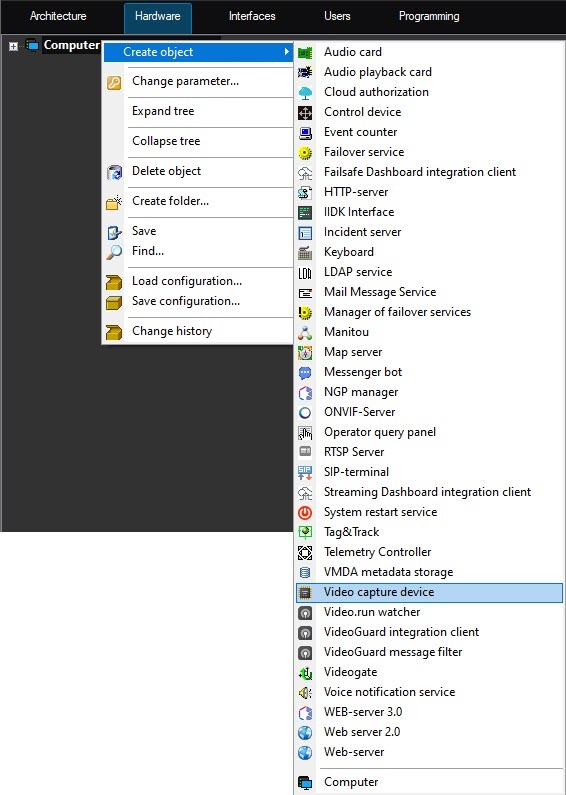
As a result, the main object settings panel is displayed.
Note
Main settings are set automatically. If necessary, you can change an ID, the object name, and the parent object.
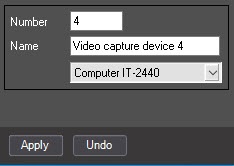
- To create the object, click the Apply button.
- Select the created object in the object tree (1).
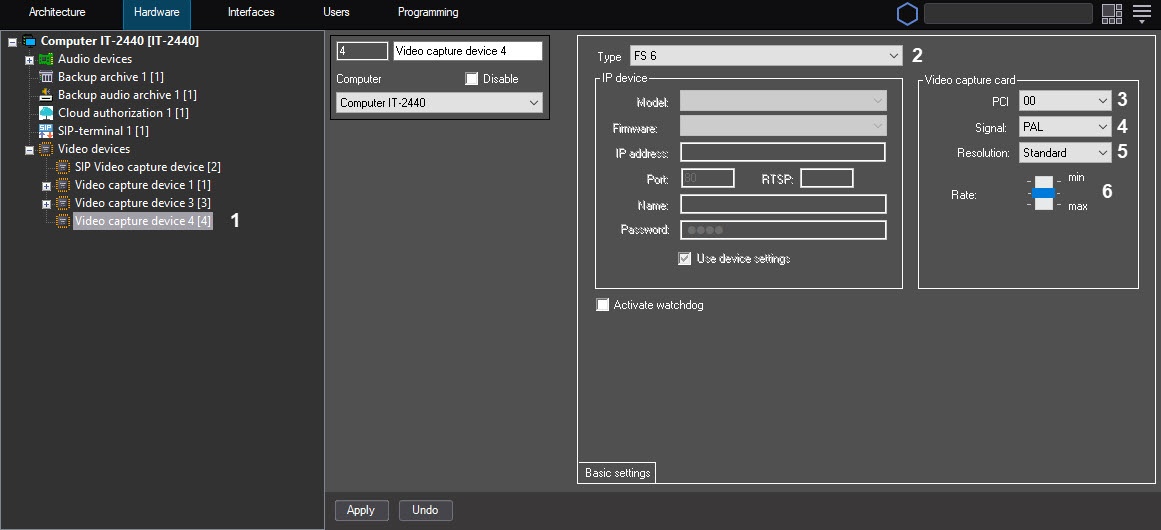
- Configure the created object.
From the Type drop-down list (2), select the type of the video capture card installed on the server.
Specify the PCI channel by selecting the value from the PCI drop-down list (3). For cards based on one chip model (ADC) and one driver (see the Drivers for video capture cards integrated into the Axxon PSIM™ software section), the allocation of PCI channels between the Video capture device objects must be performed in the end-to-end order, starting from 00. Examples of the PCI channel allocation between the Video capture device objects:
Note
When you configure the SC300Q16 (FX4), SC300D16 (FX8), SC330Q16 (analogue of SC300Q16), SC330D16 (analogue of SC300D16) video capture cards, take into account the correlation between the color of the BNC video input of the interface cable and the PCI channel specified in Axxon PSIM (see the Features of video subsystem configuration section).
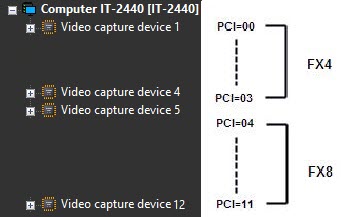
PCI channels allocation for cards based on one-chip model (ADC)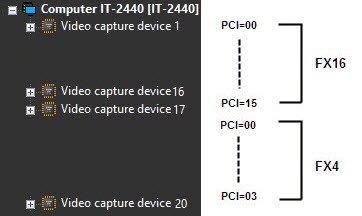
PCI channels allocation for cards based on different chip models (ADC)From the Signal drop-down list (4), select the type of the video input, PAL or NTSC.
Note
When you use the Stretch VRC 6004, VRC 6008, VRC 6416 and VRC 7008L cards, the video input (PAL or NTSC) is selected automatically depending on the camera connected to the card. The change of this parameter doesn't affect the card operation.
Note
When you use the SL16-200 (FX116)/FX416 cards, you must restart Axxon PSIM after changing the video input format. Otherwise, the previous settings are active.
From the Resolution drop-down list (5), select the resolution: Standard, High, or Full with which the video signal is captured. You must perform this action when configuring WaveHub, LinuxHub, and LinuxServer; otherwise, you can skip this step.
Specify the allowable frame rate for the card by setting the Rate slider (6) into the corresponding position.
Values of the Rate parameter:Value
Description
Max
The maximum allowable sum of video frame rate
Average
Half of the maximum allowable sum of video frame rate
Min
One-third of the maximum allowable sum of video frame rate
Click the Apply button to save the changes.
Configuring the Video capture device object is complete.
Attention!
To configure one physical video capture card, you may have to create several Video capture device objects (see Features of video subsystem configuration section).
Overview
Content Tools