
Go to documentation repository

Documentation for Axxon PSIM 2.0. Documentation for other versions of Axxon PSIM is available too.
Previous page Next page

On the page:
Creating test events
You can use test events specified by the user and generated by the utility to debug scripts in the Editor-Debugger utility. Test events aren't registered by the video surveillance system, which means they aren't displayed in the event viewer and aren't recorded to the database.
You can create no more than one test event for each script.
To create the test event, do the following:
- Select the Edit test event command in the Debug and edit menu. You can also open this panel by clicking the
 button in the toolbar.
 - The Test message window opens. This window is used to enter the parameters of the test event.
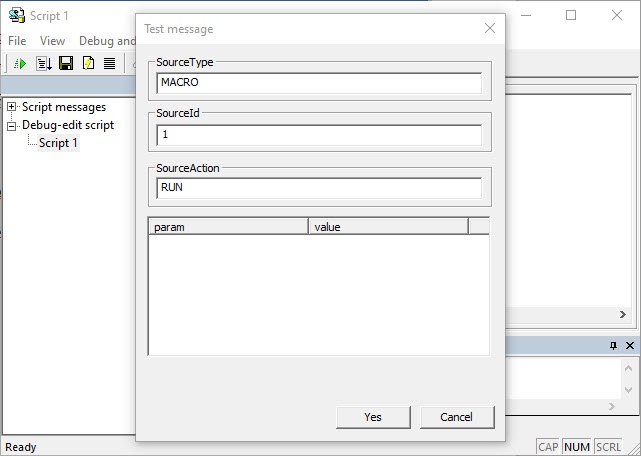
- In the fields of the Test message window, enter the following:
- SourceType—system object type;
- SourceId—system object identification number;
- SourceAction—event generated by the specified system object;
- param—additional event parameters;
- value—values of additional parameters.
Note
The main system objects, their events and parameters are described in Description of events and reactions of system objects. You can also get them using the ddi.exe utility (see Getting the list of system names of objects, reactions and events in Axxon PSIM).
- When you fill in the fields of the Test message window, click the OK button.
The process of creating the test event is complete.
After you create the test event, it is displayed in the Event field in the special string format.
The figure below shows the test event Run Macro 1.
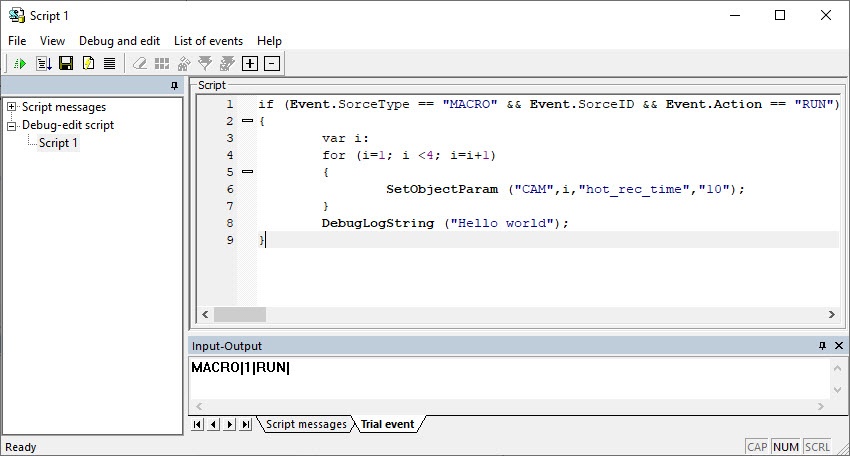
Running a script with the test event
You can run the script with the test event in one of the following ways:
- Click the Test run
 button located in the utility toolbar.
 - Select the Test run command in the Debug and edit menu.
- Select the Test run with a debugger command in the Debug and edit menu.
When you run the script using the Test run with a debugger command, the third-party debugger starts running (see Using third-party debugger programs).
The results of the verification and script execution are displayed in the corresponding debug window of the Editor-Debugger utility.
Overview
Content Tools