
Go to documentation repository

Documentation for Monitoring PSIM 2.0 (english)
Previous page Next page

To create a report, click the Alarms  button.
In the settings window that opens:
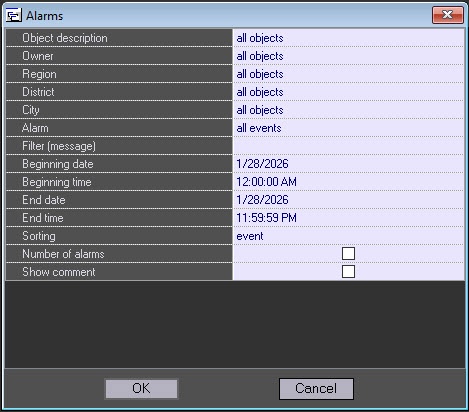
- From the Object description drop-down list, select one of three modes of creating a report:
- Report on all the system objects.

- Report on one system object.
- Report on several system objects.

- Report on all the system objects.
- Select the required values from the Owner drop-down list. This information is set on the control settings panel (for more details, see the Editing regulatory and reference information page), as well as depends on the configured filter by owners in the Monitoring reports interface object (for more details, see Configuration of the Monitoring reports object). If you select a specific object (see step 1), then this parameter is hidden in the settings window.
- From the Region, District, and City drop-down lists, select those regions, districts, and cities where the objects are placed. This information is set on the control settings panel (for more details, see the Editing regulatory and reference information page). If you select a specific object (see step 1), then this parameter is hidden in the settings window.
- From the Alarm drop-down list, select the alarms by which a report is created. You can also create a report on all alarms that occurred within the set period.
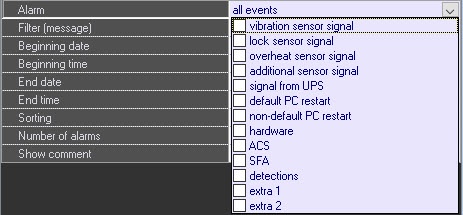
In the Filter (message) field, set, if necessary, the text filter by the messages of monitored alarms (see Configuration for associating events with certain alarm groups).

Note
The Filter (message) field is auto-filled. Each text filter entered in this field is stored in the database and automatically inserted into the field upon retyping.
- Set the values of the Beginning date, Beginning time, End date, and End time fields to specify the time range of alarm occurrences by which a report is created.
- From the Sorting drop-down list, select one of two modes:
- event—sorting by events (Vibration sensor signal, Lock sensor signal, and so on).
- time—sorting by the event beginning time.

- Set the Number of alarms checkbox to create a report about the number of alarm events within the set period specified in step 6. By default, the checkbox is cleared, that is, a report is created by all alarms throughout the specified time interval without counting their number.
- If you set the Number of alarms checkbox, the following fields are displayed:
- Format—from the drop-down list, select the time format when several recurring alarms are considered as one: Days, Hours, Minutes (the default value), Seconds.
- Duplicate filter—specify the period when several recurring alarms are considered as one. The default value is 5. If the value of the Duplicate filter field equals 0, the number of all alarms specified in step 6 are counted.

- Set the Show comment checkbox to display alarm reports in the comment (see Processing alarms).
- Click the OK button.
As a result, a report about alarm events is created.
Example of a report on all alarm events (the Number of alarms checkbox isn't set):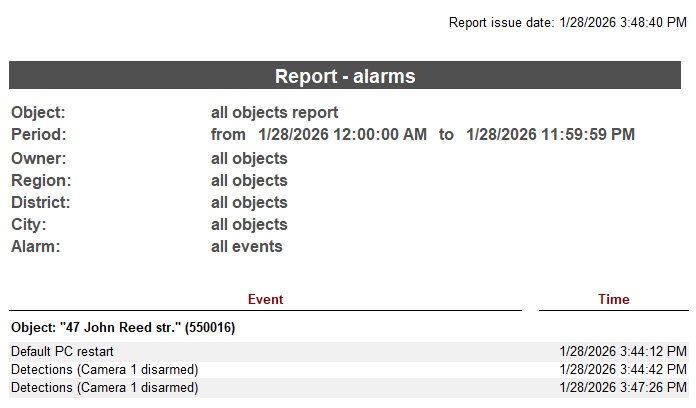
Example of a report on the number of alarm events with the set duplicate filter that equals one day: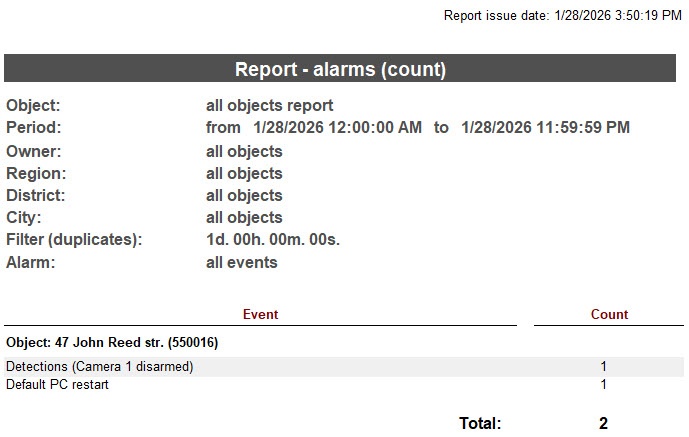
The new Duplicate filter field appears in the common data at the top of the page.
Creating a report about alarms is complete.
Overview
Content Tools