
Go to documentation repository

Documentation for Monitoring PSIM 2.0 (english)
Previous page Next page

To create a report, click the Statistics  button.
In the settings window that opens:
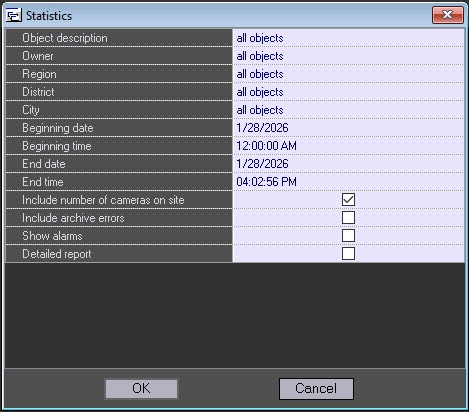
- From the Object description drop-down list, select one of three modes of creating a report:
- Report on all the system objects.

- Report on one system object.
- Report on several system objects.

When you select a report on all objects or on several objects, the Detailed report checkbox is displayed. By default, the Detailed report checkbox is cleared, that is, the system creates the common statistic report. If you set the Detailed report checkbox, then the system creates a detailed statistic report and displays the Availability factor threshold, Sorting, and Sort parameters.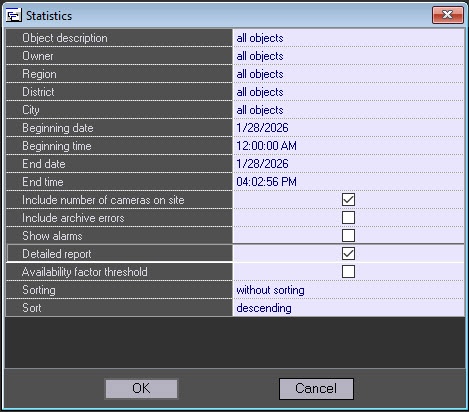
- Set the Availability factor threshold checkbox to filter objects by the additional condition, the availability factor threshold value, to display the Threshold value, % and Condition parameters:
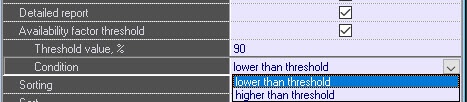
- In the Threshold value, % field, specify the threshold value as a percentage in the range from 0 to 100;
- From the Condition drop-down list, select the condition of objects filtering: lower than threshold or higher than threshold.
- From the Sorting drop-down list, select the sorting criterion.
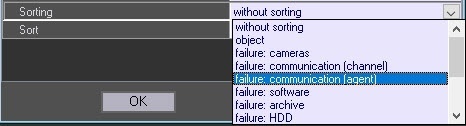
- From the Sort drop-down list, select the sorting order: ascending or descending.

- Set the Availability factor threshold checkbox to filter objects by the additional condition, the availability factor threshold value, to display the Threshold value, % and Condition parameters:
- Report on one system object.
When you select a specific object, the Provide info about alarms and Provide info about failures parameters are displayed, where:- Set the Provide info about alarms checkbox to include the detailed information about alarms on an object in a report.
- Set the Provide info about failures checkbox to include detailed information about failures on an object in a report.
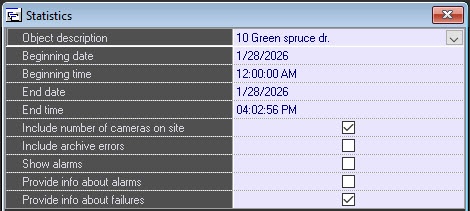
- Report on all the system objects.
- Select the required values from the Owner drop-down list. This information is set on the control settings panel (for more details, see the Editing regulatory and reference information page), as well as depends on the configured filter by owners in the Monitoring reports interface object (for more details, see Configuration of the Monitoring reports object). If you select a specific object (see step 1), then this parameter is hidden in the settings window.
- From the Region, District, and City drop-down lists, select those regions, districts, and cities where the objects are placed. This information is set on the control settings panel (for more details, see the Editing regulatory and reference information page). If you select a specific object (see step 1), then this parameter is hidden in the settings window.
- Set the values of the Beginning date, Beginning time, End date, and End time fields to specify the time interval by which a report is created.
- Set the Include number of cameras on site checkbox to calculate unavailability factors, taking into account the total number of cameras on an object.
- Set the Include archive errors checkbox to take into account unavailability factors by archives when you calculate the unavailability factor of the entire system.
- Set the Show comment checkbox to add information about alarm events on system objects to a report.
- Click the OK button.
Example of a statistic report on one object:
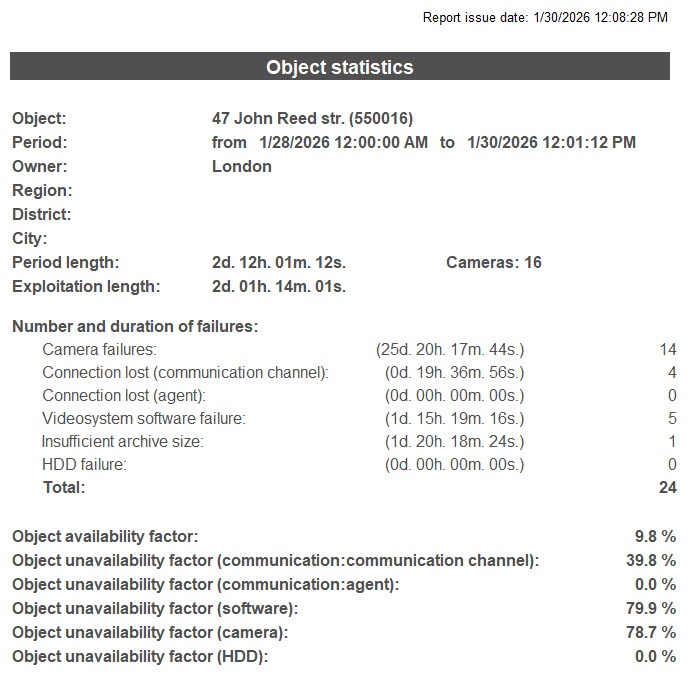
The following figure shows an example of different failures at the object by which availability and unavailability factors are calculated.
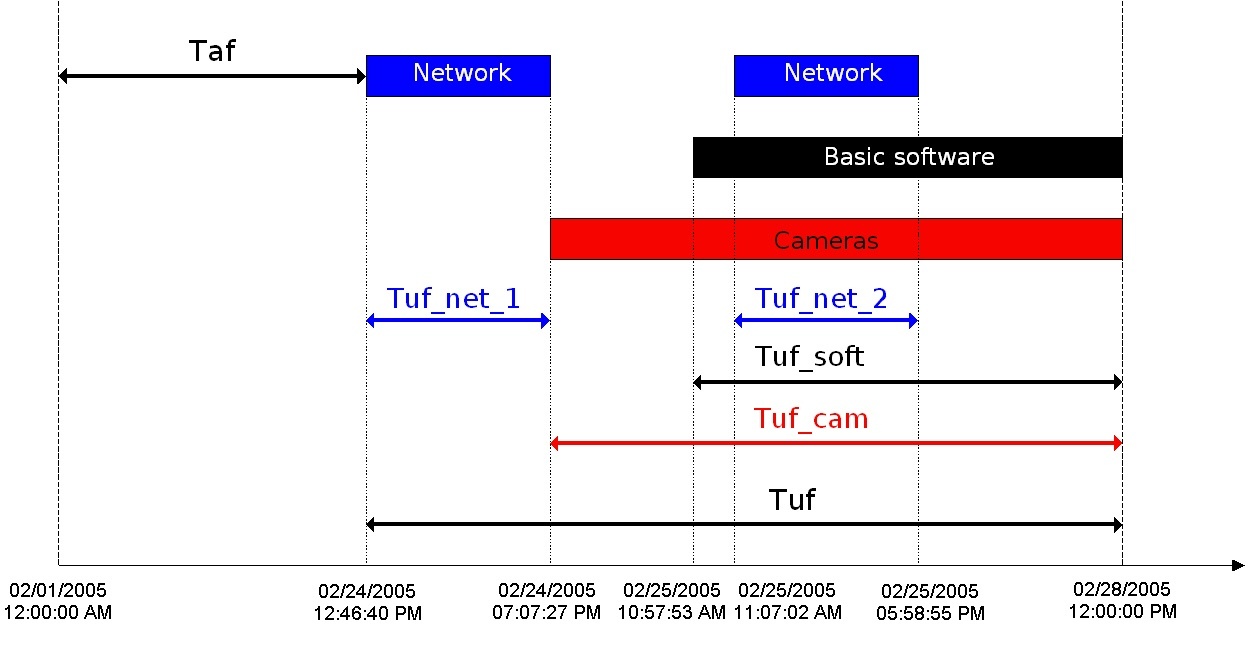 In this example, the statistic report is created during the period from 12 a.m. on February 1, 2005, to 12 p.m. on February 28, 2005. The availability factor of an object is calculated as a ratio between the duration of the period when the object was functioning and the duration of the period by which a report is created:
Rr = Taf/(Taf+Tuf)
The considerable types of failure (that take part in calculation) are used:
- connection;
- basic software;
- cameras.
In our example, the object unavailability factors for these failures are calculated according to the formulas given below.
The unavailability factor of the (connection) object:
Rn_c = (Tuf_net_1 + Tuf_net_2)/(Taf+Tuf)
The unavailability factor of the (software) object:
Rn_sw = Tuf_soft/Taf+Tuf
The unavailability factor of the (cameras) object:
Rn_cam = Tuf_cam/Taf+Tuf
Generally, in the used model, the general Rn unavailability factor isn't equal to the sum of unavailability factors by separate failures.
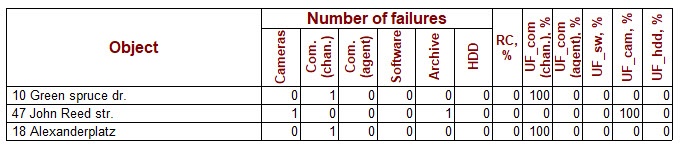
The following figure shows the example of the general report for the entire system.
Availability and unavailability factors are calculated as the arithmetic mean.
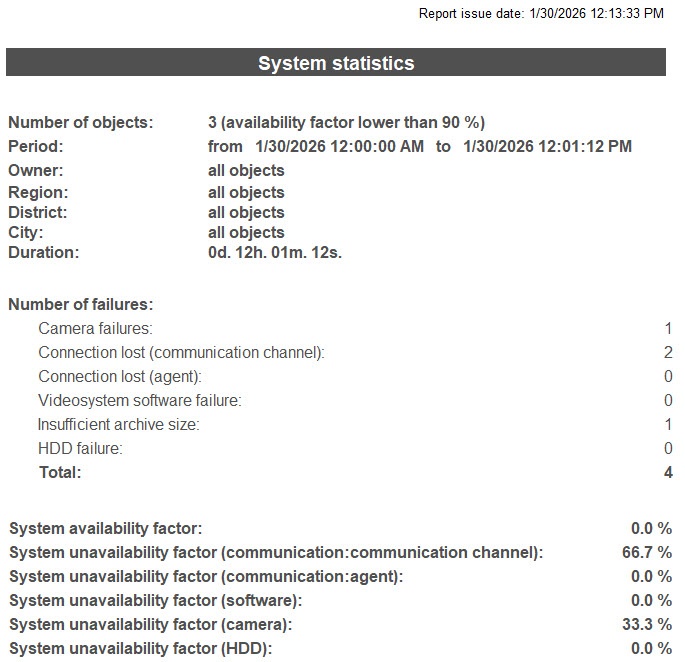
When you create a detailed report for the entire system, except for the general information page, the table with detailed data for each object is displayed.
Attention!
If the number of failures for any object exceeds 1000 throughout the specified period, this object is excluded from the statistic report across the entire system, however, it gets on the list of such problem objects.
Creating the statistical report is complete.
Overview
Content Tools