
Go to documentation repository
Documentation for Axxon One 2.0 version. Documentation for Axxon One 3.0 version is also available.

In Axxon One, you can work with virtual cameras.
This method requires running Axxon One in the test mode and imitating a stream of video data by playing an available video. You can play videos using video compression algorithms supported by Axxon One (see Characteristics of Axxon One).
To create and configure a virtual camera:
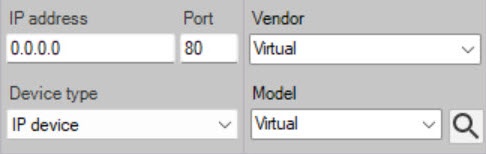
- Run the IP Device Discovery Wizard (see Searching, adding, configuring, and removing IP devices).
- From the Vendor drop-down list, select Virtual.
Select Virtual from the Model drop-down list to emulate a single-stream camera. From the Model drop-down list, select Virtual several streams to emulate a camera supporting multiple streams.
Click the
 button.
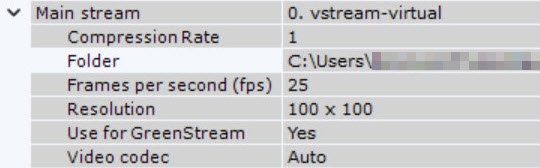
In the Folder field, specify the storage location of the video that you want to use to imitate a video signal.
Attention!
- You must not use video with B-frames. You can check the presence of B-frames in a video using the ffprobe utility that is included in the FFmpeg package:where, instead of d:\Dev!temp\1.avi, specify the actual path to the file. The output value:
ffprobe -v error -select_streams v:0 -show_entries stream=has_b_frames -of default=noprint_wrappers=1:nokey=1 d:\Dev\!temp\1.avi
- 0—there are no B-frames in the video.
- greater than 0—the video contains B-frames.
- You must not use the H.263 codec. You can identify the codec, for example, using the MediaInfo utility.
- If there are many files in the folder, they are played in a random order.
- Scanning for files in a specified directory is limited to one minute.
- You must not use video with B-frames. You can check the presence of B-frames in a video using the ffprobe utility that is included in the FFmpeg package:
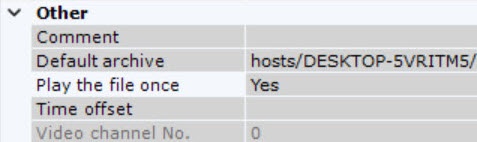
By default, the video is played in a loop. To play the video once, select Yes in the Play the file once parameter.
- Click the Apply
 button.
Creating and configuring a virtual camera is complete.
Overview
Content Tools