
Go to documentation repository

Documentation for Axxon PSIM 2.0. Documentation for other versions of Axxon PSIM is available too.
Previous page Next page

On the page:
General information on GB/T28181 standard and supported functions
Axxon PSIM allows connecting devices via the chinese standard GB/T28181. This protocol is based on the SIP over UDP protocol (and over TCP starting with the GB/T28181-2016 version). The GB/T28181 protocol uses the following protocols over SIP:
- SDP (Session Description Protocol)
- MANSCDP (Monitoring and Alarming Network System Control Description Protocol)
- MANSRTSP (Monitoring and Alarming Network System Real Time Streaming Protocol)
This allows receiving the status of sensors, events from detectors, PTZ and relays control, access to the embedded archive of the IP device (you must set the correct device time zone in Axxon PSIM beforehand), within the SIP session, and so on. The operation with single-channel and multi-channel devices in single-stream mode and with the UDP and TCP transport protocols is also supported.
At the same level of the OSI model, the RTP/RTCP protocol also works in parallel with the SIP protocol, which makes it possible to use the following functions:
- video transmission (including archive one) in H264, H265, or MJPEG formats.
- audio transmission in G.711a, G.711u, or G.726 formats in the PS (Program Stream) stream only. Audio from the archive isn't supported.
For the most up-to-date information on this standard and the features supported in Axxon PSIM, see the Documentation Drivers Pack.
Configuring an IP-device to operate via the GB/T28181 standard
To configure IP devices connected via the GB/T28181 protocol, use the web interface of these IP devices. The settings aren't sent from Axxon PSIM to the device.
Before you connect the IP device via this protocol to Axxon PSIM, you must set the SIP settings on the IP device in the following way:
- Set the Server IP parameter equal to the server's IP address.
- Set the Server port parameter (5060 by default).
- Set the Device ID parameter. This parameter must be set on all cameras connected via the GB/T28181 protocol and must be unique. The format of the connection code (device ID and server ID) is a 20-digit number:
- the first 10 digits specify the address (according to the GB/T-2260-2007 standard);
- the next 10 digits specify the device information.
If the IP device is located behind NAT, you must forward and explicitly specify the external address of the server, the port/port range for receiving video, and the SIP port of the Axxon PSIM server. Example: 34020000001110000001/50557-51557@10.3.3.11/85.172.174.36
- the first 10 digits specify the address (according to the GB/T-2260-2007 standard);
- If you want the device to detect the server more quickly, reduce the default value of the RefreshRegTime parameter. The name of this setting can differ on different IP devices.
Note
For the telemetry to work correctly on the IP device, set the value of the RefreshRegTime parameter to more than 600.
See also Examples of IP device settings for connection via GB/T28181 standard.
Configuring IP-device connection via the GB/T28181 standard
Attention!
The system supports the operation of IP devices via the GB/T28181 protocol with no more than one SIP server. This means that you can create several Video capture device objects with the GBT28181 type in the Axxon PSIM hardware tree, however, the part of the address after @ must match for all of them. The server ID, local address, external address, and port must be the same for all devices. If at least one parameter is different (for example, the local IP address isn't set for some device when it is set for other devices), then such a device doesn't start.
Note
Axxon PSIM doesn't support the automatic search of devices connected via the GB/T28181 protocol, and when you add them using the Camera discovery tool.
After you configure the device as described above, add it to Axxon PSIM as follows:
- Go to the Hardware tab of the System settings dialog window (1).
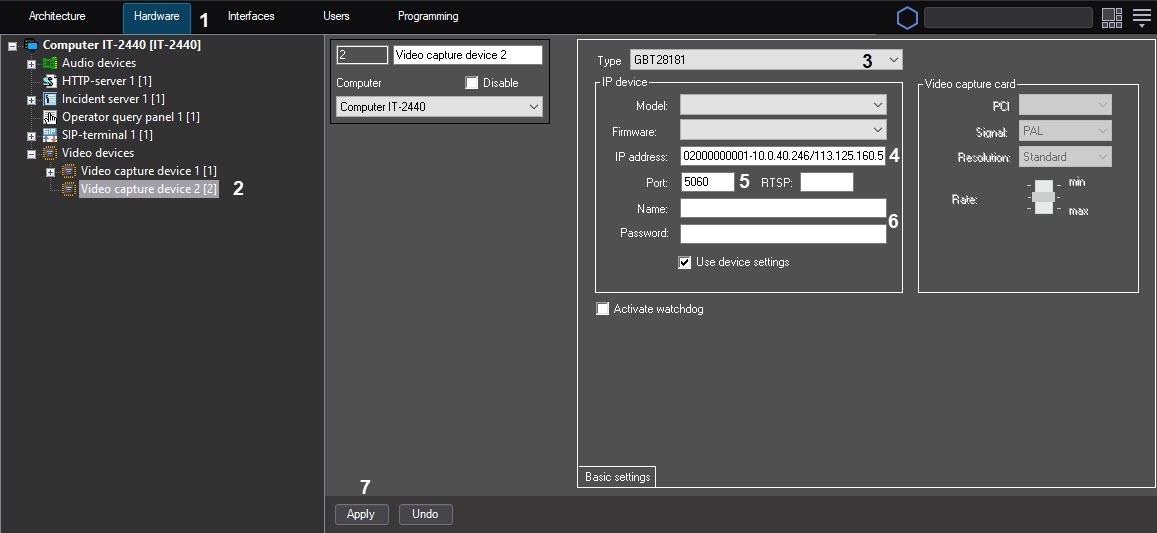
- Create the Video capture device object on the basis of the Computer object (2). The settings panel of this object appears on the right part of the System settings window.
- From the Type dropdown list (3), select the GBT28181 value.
- In the IP field (4), specify the value in the following format:
[gbt://]deviceID[/videoPort]@serverID[-serverLocalIP[/serverExternalIP]]
or
[gbt://]deviceID[/videoPortFirst-videoPortLast]@serverID[-serverLocalIP[/serverExternalIP]]
where:
deviceID is the Device ID parameter specified during the IP device setup;
serverID is the identifier of the Axxon PSIM server created according to the same rules as the IP device ID (see above);
videoPort is the port for receiving video;
videoPortFirst-videoPortLast is range of ports for receiving video;
serverLocalIP is the local IP address of the Axxon PSIM server, which sets the network interface on which the server will be available;
serverExternalIP is the global IP address of the Axxon PSIM server; this parameter is used when the Axxon PSIM server is behind the gateway. In this case, this IP address is specified as the SIP server address in the IP device settings.Examples
34020000001320000008@34020000002000000001
34020000001320000008@34020000002000000001-10.0.40.246/113.125.160.58
34020000001320000008@34020000002000000001-10.0.40.246
34020000001320000008@34020000002000000001-/113.125.160.58
34020000001320000008/50200@34020000002000000001
34020000001320000008/50200-50210@34020000002000000001-10.0.40.246
In the Port field (5), enter the local port number that the Axxon PSIM server will "listen" to receive messages from the IP device.
Usually this is the default SIP port—5060.Note
The SIP port of the IP device is detected automatically.
- The Name and Password fields aren't used (6).
- Click the Apply button (7).
- Create the Camera object on the basis of the Video capture device object. The settings panel of this object appears on the right part of the System settings window.
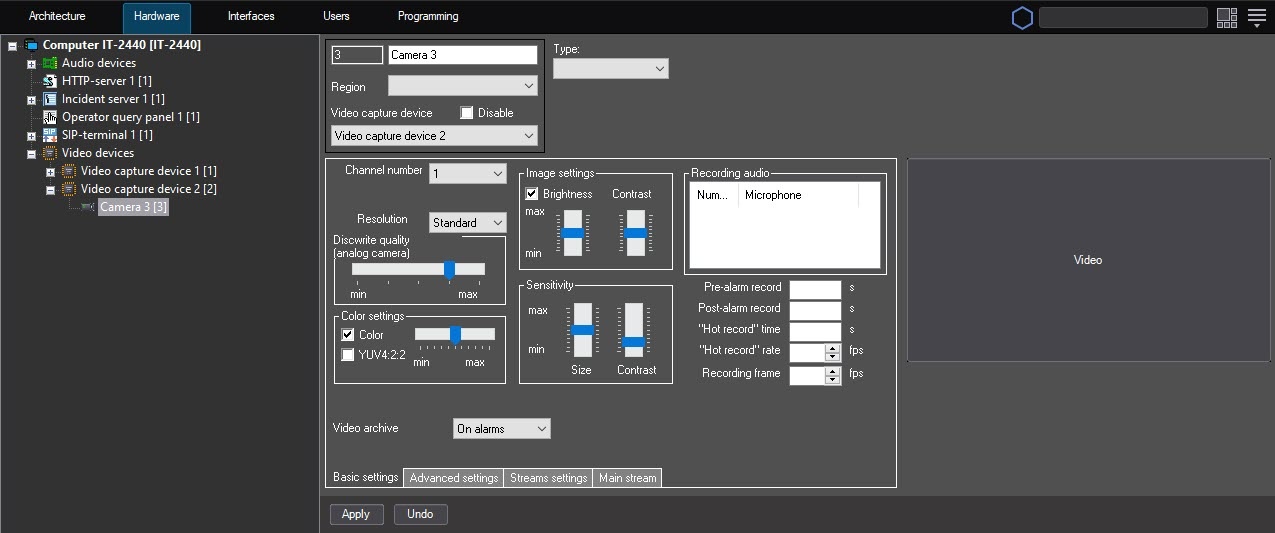
- Click the Apply button.
Further work with the device (for example, displaying video on the monitor, archive recording) is performed using the created Camera object—see the Configuring video subsystem section in the Administrator's Guide document. The PTZ and relay management functions, access to the embedded storage, and so on are configured in the same way as for ordinary IP devices and described in the corresponding sections of this document Guide for installing and configuring security system components.
Adding the device that operates via the GB/T28181 protocol is complete.
Overview
Content Tools