
Go to documentation repository
Documentation for Axxon One 3.0/3.1 version. Documentation for Axxon One 2.0 version is also available.

Hardware requirements for License plate recognition RR—Parking
Camera requirements for License plate recognition RR—Parking and its sub-detectors
Recommendations for configuring the speed detection area for License plate recognition RR—Parking
Optimizing the operation of License plate recognition RR—Parking on GPU in Windows OS
Optimizing the operation of License plate recognition RR—Parking on GPU in Linux OS
Parameters that specify the conditions for starting a macro when recognizing a vehicle
Examples of macros used when working with lists of license plates
To configure the License plate recognition RR—Parking detector, do the following:
- Go to the Detectors tab.
- Below the required camera, click Create… → Category: Vehicle → License plate recognition RR—Parking.
By default, the detector is enabled and set to recognize vehicle license plates in the parking lot.
If necessary, you can change the detector parameters. The list of parameters is given in the table:
| Parameter | Value | Description |
|---|---|---|
| Object features | ||
| Video stream | Main stream | If the camera supports multistreaming, select the stream for which detection is needed. Selecting a low-quality video stream reduces the load on the server |
| Check in lists | Yes | The parameter is disabled by default. If you want to use this detector to check in lists of license plates, select the Yes value (see Checking in lists of LPs) |
| No | ||
| Record objects trajectories | Yes | The metadata of the video stream is recorded to the database by default. Object trajectories are used to search in the archive (see Search in archive). To disable the parameter, select the No value |
| No | ||
| Object identification | ||
| Name | License plate recognition RR—Parking | Enter the detector name or leave the default name |
| Enable | Yes | The detector is enabled by default. To disable the detector, select the No value |
| No | ||
| Type | License plate recognition RR—Parking | Name of the detector type (non-editable field) |
| Decoder mode | Auto | Select a processing resource for decoding video streams. When you select a GPU, a stand-alone graphics card takes priority (when decoding with Nvidia NVDEC chips). If there is no appropriate GPU, the decoding will use the Intel Quick Sync Video technology. Otherwise, CPU resources will be used for decoding |
| CPU | ||
| GPU | ||
| HuaweiNPU | ||
| Period of ignoring repeated recognitions (sec) | 0 | Enter the time in seconds during which repeated recognitions of license plates are ignored. The value must be in the range [0, 86400] |
Country selection Attention! The more countries you select, the slower the recognition process and the higher the probability of errors in the recognition of license plates. | ||
| Countries | (Select all), Argentina, Armenia, Austria, Azerbaijan, Belarus, Belize, Belgium, Brazil, Brunei, Bulgaria, Chile, China, Colombia, Croatia, Cyprus, Czech Republic, Denmark, Egypt, Estonia, Finland, France, Georgia, Germany, Greece, Honduras, Hungary, Indonesia, Ireland, Italy, Ivory Coast, Kazakhstan, Kyrgyzstan, Latvia, Lithuania, Luxembourg, Malaysia, Malta, Mexico, Moldova, Myanmar, Netherlands, | The Not used value is selected by default. In the window that opens, set one or several checkboxes next to the countries whose license plates must be recognized. Click the Apply button. To cancel the selection of countries, click the Cancel button |
| Country name 1 (deprecated) | (Not used), Argentina, Armenia, Austria, Azerbaijan, Bulgaria, Brunei, Belarus, Belize, Brazil, Belgium, China, China, Cyprus, Ivory Coast, Czech Republic, Germany, Colombia, Denmark, Estonia, Egypt, Finland, France, Georgia, Greece, Croatia, Honduras, Hungary, Indonesia, Ireland, Italy, Kyrgyzstan, Kazakhstan, North Korea, Lithuania, Luxembourg, Latvia, Malta, Malaysia, Mexico, Moldova, Myanmar, Netherlands, | Attention! Starting with Detector Pack 3.17.1, this parameter is deprecated. Its value is only taken into account if you select the Not used value in the Countries parameter. Otherwise, this parameter is ignored. Argentina is selected by default. From the drop-down list, select one country whose license plates are actually found in the detection area and which need to be recognized |
| Country name 2 (deprecated) | ||
| Country name 3 (deprecated) | ||
| Country name 4 (deprecated) | ||
| Country name 5 (deprecated) | ||
| Basic settings | ||
| Detection mode | CPU | Select a processor for the detector operation (see Selecting Nvidia GPU when configuring detectors) Attention! It can take several minutes to launch the algorithm on Nvidia GPU. You can use caching to speed up future launches (see Optimizing the operation of License plate recognition RR—Parking on GPU in Windows OS, Optimizing the operation of License plate recognition RR—Parking on GPU in Linux OS).
|
| Nvidia GPU 0 | ||
| Nvidia GPU 1 | ||
| Nvidia GPU 2 | ||
| Nvidia GPU 3 | ||
| Intel GPU 0 | ||
| Intel GPU 1 | ||
| Intel GPU 2 | ||
| Intel GPU 3 | ||
| Vehicle recognition | Yes | The parameter is disabled by default. If you want to search for vehicles in the archive by vehicle make, model, vehicle class, or other specified criteria, select the Yes value (see Search by LPs) Note The accuracy of the Vehicle recognition parameter:
Recognition accuracy is affected by the camera angle, the illumination in the detection area, as well as compliance with camera requirements and video stream quality (see Camera requirements for License plate recognition RR—Parking and its sub-detectors). |
| No | ||
| Info on unrecognized LPs | Yes | The parameter is disabled by default. If it is necessary to find all possible information about a vehicle with unrecognized license plate, select the Yes value Attention! For the parameter to work correctly, you also need to enable the Vehicle recognition parameter. |
| No | ||
| Algorithm for detecting vehicle direction | By LP coordinates | The By LP coordinates algorithm is used by default. It works as follows: if the coordinates of the vehicle license plate shift from top to bottom (the vehicle moves towards the camera) and if the coordinates of the vehicle license plate shift from bottom to top (the vehicle moves away from the camera). Select the By LP scale change parameter if, in the surveillance window, the scale of the vehicle license plate increases (the vehicle moves towards the camera) and if the scale of the vehicle license plate decreases (the vehicle moves away from the camera) |
| By LP scale change | ||
| Direction of movement | Both | By default, an event is created when a vehicle moves in Both directions. If you want the event to be created when a vehicle moves from the camera (Outgoing) or to the camera (Incoming), select the corresponding value |
| Outgoing | ||
| Incoming | ||
| Advanced settings | ||
| Track lifespan | Yes | By default, the parameter is disabled. If you want to view the track lifespan for an object in seconds, select the Yes value |
| No | ||
| Vehicle recognition period (ms) | 750 | Specify the period in milliseconds during which the vehicle is recognized. The value must be in the range [1, 10000] |
| Minimum vehicle recognition quality (%) | 30 | Specify the minimum quality of vehicle recognition as a percentage. The lower the minimum recognition quality, the more events are created, but the lower the reliability of recognition. The higher the value, the stricter the filtering and the higher the accuracy. The value must be in the range [0, 100] |
| Number of frames for analysis (Intel GPU only) | 8 (low latency and low performance) | Attention! The parameter is active only if you select the Intel GPU 0, 1, 2, or 3 values in the Detection mode parameter. The parameter determines how many frames are buffered before being sent simultaneously to the neural network model for processing. This mechanism optimizes the load on the Intel GPU. The higher the value, the higher the latency and performance. The default value is 8 (low latency and low performance) |
| 16 (medium latency and medium performance) | ||
| 32 (high latency and high performance) | ||
| Accuracy and performance | Medium accuracy and high performance | Select vehicle recognition accuracy and performance:
|
| High accuracy and medium performance | ||
| Minimum LP recognition quality (%) | 80 | Specify the minimum quality of license plate recognition as a percentage. The higher the minimum recognition quality, the fewer false events. The value must be in the range [0, 100] |
| Initiate event in (sec) | 0 | Specify the time in seconds after which an event must be generated after recognizing a license plate in the frame. If the value is 0, an event is generated after the track with a license plate is lost. The value must be in the range [1, 3600] |
| Frame size change | 1920 | The analyzed frames are scaled down to a specified resolution (1920 pixels on the longer side) by default. The value must be in the range [640, 10000]. The following algorithm is used:
Note For example, the source image resolution is 2048*1536, and the specified value is set to 1000. In this case, the source resolution will be halved two times (512*384), as after the first division, the number of pixels on the longer side exceeds the specified value (1024 > 1000). If detection is performed on a higher resolution stream and detection errors occur, we recommend reducing the compression. |
| Speed estimation | ||
| Speed detection | Off | Select from the list the mode for determining the speed unit of vehicles. Attention! The margin of error in determining the speed of vehicles is about 5% with a good calibration, as this function gives only a general idea of the situation. The consumption of resources doesn't change when the Speed detection parameter is enabled. Note For the correct displaying of the speed measurement unit, you must create the MEASUREMENT_UNIT system variable (see Creating system variable) and specify the value:
|
| Kmph | ||
| Mph | ||
| Calibration area width (m) | 0 | Specify the width of the calibration area in meters. The value must be in the range [0, 500] |
| Calibration area height (m) | 0 | Specify the height of the calibration area in meters. The value must be in the range [0, 500] |
| Minimum distance for speed calculation (m) | 4 | Specify the minimum distance in meters for speed calculation. The value must be in the range [0, 100] |
If necessary, in the preview window, you can set:
- The calibration area of the road scene. To do this, do the following:
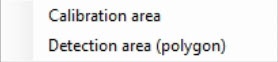
- Click in the camera preview window and select Calibration area.
You can configure the calibration area by moving the anchor points . The calibration area is used to match the camera coordinates with the real road scene. The calibration area must also be set in cases where it is necessary to determine the vehicle speed. It is necessary to set an area that corresponds to a certain real rectangle of known dimensions in the frame. For example, road markings, a vehicle, and so on. You must configure the calibration area so that it is parallel to the ground surface.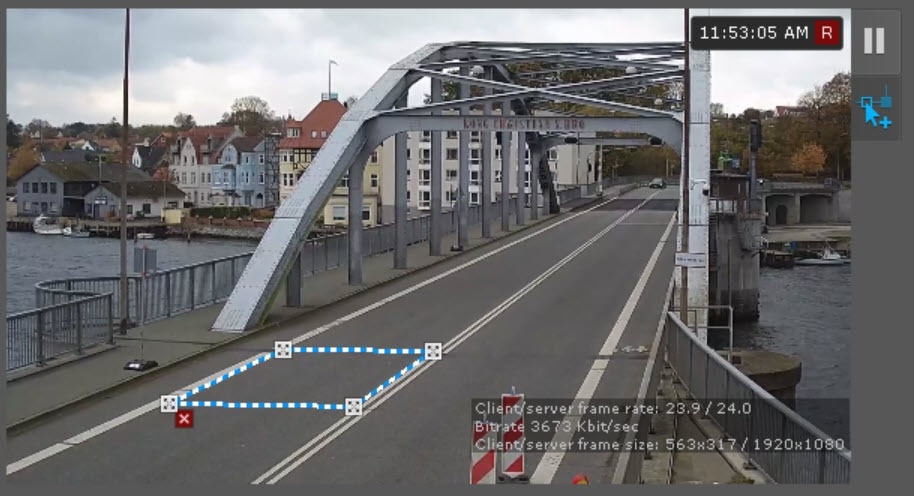
- Specify the dimensions of the real rectangle on the frame. This rectangle corresponds to the area marked in the Calibration area height (m) and Calibration area width (m) parameters.
- Click in the camera preview window and select Calibration area.
- The detection area. To do this, do the following:
- Click in the camera preview window and select Detection area (polygon).
You can configure the detection area by moving the anchor points. The detection area is used to detect vehicles or license plates and generate corresponding events.
- Click in the camera preview window and select Detection area (polygon).
Note
- For convenience of configuration, you can "freeze" the frame. Click the
 button. To cancel the action, click this button again.
 - To hide the area, click the
 button. To cancel the action, click this button again.
 - To delete a selected area, click the
 button.
To save the parameters of the detector, click the Apply  button. To cancel the changes, click the Cancel
  button.
Configuration of the License plate recognition RR—Parking detector is complete. If necessary, you can create and configure the necessary sub-detectors on the basis of License plate recognition RR—Parking (see Standard sub-detectors).
Overview
Content Tools