
Go to documentation repository

Documentation for Axxon PSIM 2.0. Documentation for other versions of Axxon PSIM is available too.
Previous page Next page

On the page:
The process of configuring Axxon PSIM system objects can include the following stages:
Selecting object
To select an object, do the following:
- Open the Hardware tab containing the objects tree.
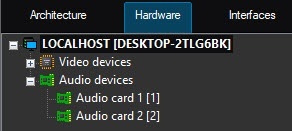
- Select an object in the objects tree by clicking it with the mouse.
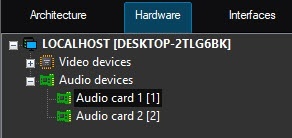
Creating object
To create an object, do the following:
- Open the Hardware tab containing the objects tree.
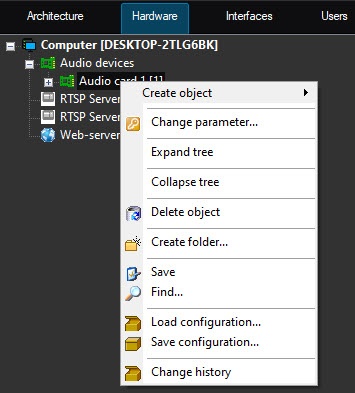
- Select the parent object in the objects tree on the basis of which you want to create the child object.
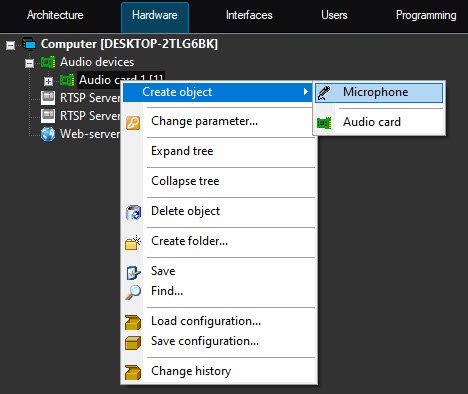
- Display the context menu by clicking the right mouse button and select the Create object item.
- Select the type of the created object in the corresponding second-level menu.
As a result, the identification panel of the created object is displayed on the object's settings panel.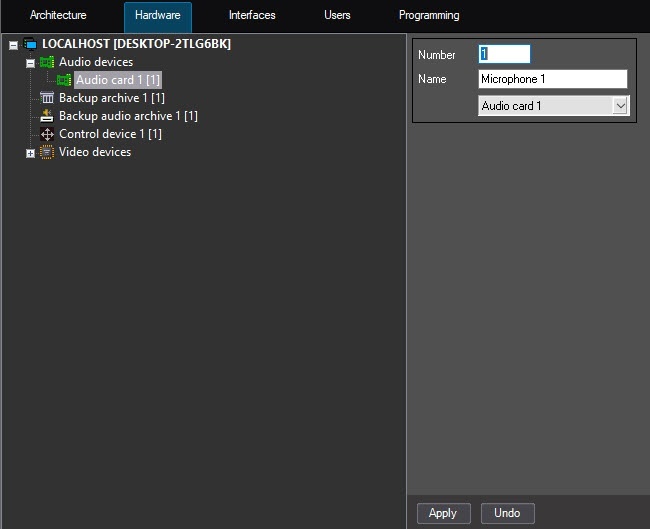
- Enter the unique identification number in the Number field (1) and the unique name of the created object (in the considered example—the Microphone object) in the Name field (2).
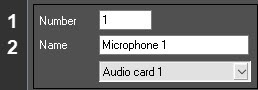
Note
The list of restrictions for using characters for the object identifiers (Numbers) is given on the Identifiers (numbers) of system objects page.
In the Name field, you cannot use the > and < characters. If you use these characters in the object name, they are removed when you apply the settings.
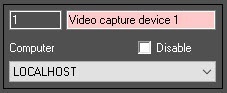
If the entered identifier or name already exists in the system, the panel displays the corresponding message, and the field is highlighted in red.
- Click the Apply button to complete the object creation process.
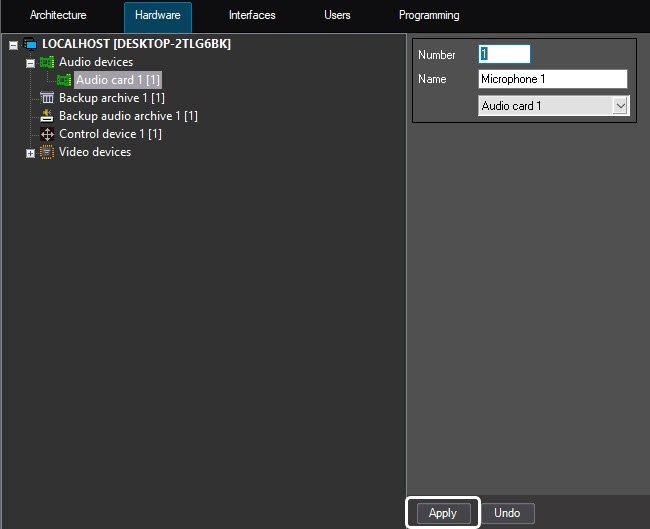
As a result, the new child object is created on the basis of the selected parent system object.
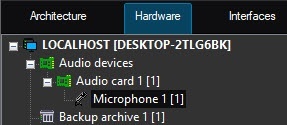
Note
If the parent system object has one or more child objects, then you can expand the list of child objects using the
 icon and collapse the list using the
  icon.
icon.
Editing
Editing is any change in the object settings, that is, changing the object parameter values. The settings panel of the system object is the main tool for setting the properties of the given object.
To edit an object, do the following:
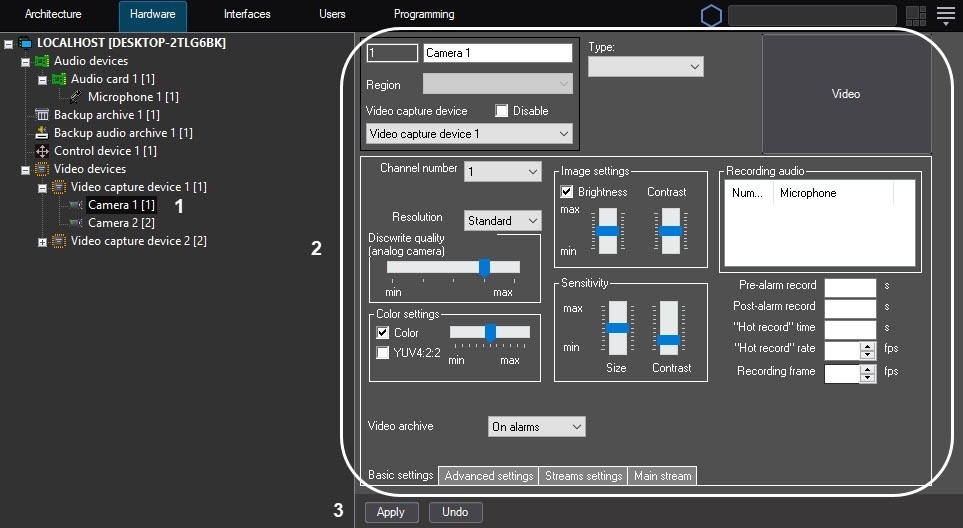
- Select the system object for editing its parameters in the objects tree by clicking it (1).
- Make changes in the object parameter values using the settings panel of the given object (2).
Note
The object ID is always unavailable for editing.
You can change the object name, however, if the object with this name already exists, the corresponding message appears when you apply the settings:
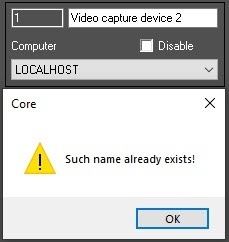
- Click the Apply button to save the changes (3).
Changing the parent object
When you change the parent object, you can move the created object in the Axxon PSIM hardware tree without losing the settings saved. To change the parent object, do the following:
- Select the system object the position of which you want to change in the hardware tree.
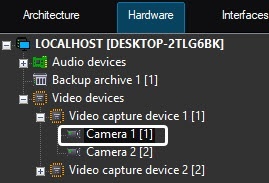
Select the new parent object from the drop-down list on the object settings panel. The name of the drop-down list corresponds to the name of the parent object type.
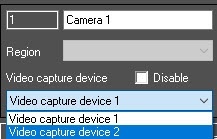
Note
If you move an object to another computer, you must restart Axxon PSIM for the correct operation of the moved objects on both computers—on the one where you move an object and the one from which you move an object.As a result, the object is displayed in the objects tree under the selected parent object.
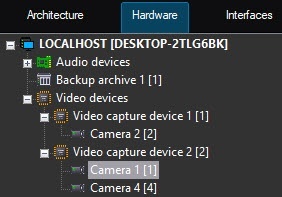
Copying objects
The copy function allows cloning objects created in the Axxon PSIM objects tree (see also copying objects by creating a template—The Save function).
Note
The function of copying is guaranteed for the Video capture device object and its child objects: Camera, Sensor, Relay, Embedded detector, Face detector, Detection zone, Tracker, VMDA detector and Captioner. For other objects this function isn't guaranteed.
To copy the objects, do the following:
- Select an object that must be copied in the objects tree.
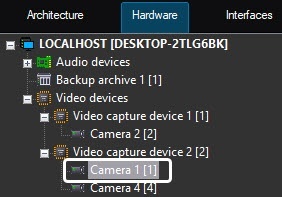
- To copy the object, press the Ctrl+C key combination.
- Select the parent object on the basis of which the copy of the selected object must be created or one of the objects created on the basis of such parent object.
If the copy must be created on the basis of the same parent object as the source object, then you can skip this step. - Paste the object using one of the following key combinations:
- Ctrl+V—paste only the copied object.
- Ctrl+Shift+V—paste the copied object with all child objects.
The object or objects are created with default names, and they are assigned the next free ID in order. The parameters of the created objects are the same as those of the corresponding source objects.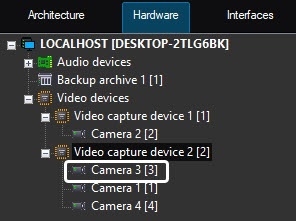
Note
You can paste the copied object multiple times. The copied object is stored in the clipboard until you restart Axxon PSIM or until the clipboard content is replaced by the new copied object.
Enabling or disabling objects
To disable an object, do the following:
- Select an object in the tree (1).
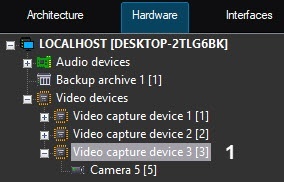
- On the settings panel, set the Disable checkbox (2) and click the Apply button (3).
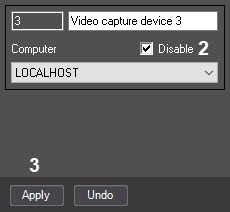
- As a result, the
 symbol appears next to the disabled object (4).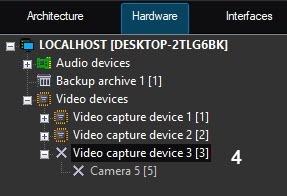
To enable an object, clear the Disable checkbox on the settings panel and click the Apply button.
Note
When you disable an object, you disable all its child objects.
Restoring the object settings
To restore the object settings, do the following:
- In the objects tree, select the object whose settings you want to restore.
- Open the context menu using the right mouse click.
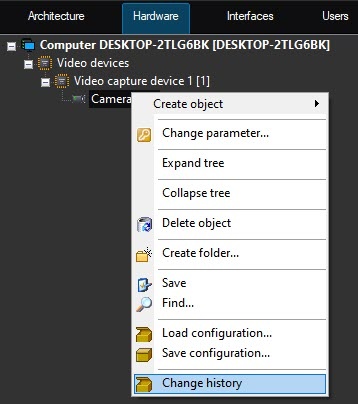
- Select the Change history menu item.
As a result, the Settings restoration window opens.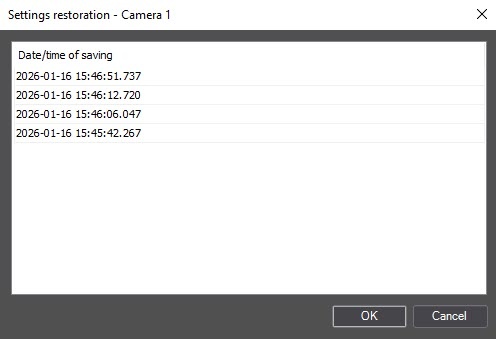
- Select the required version of object changes from the Date/time of saving list.
Note
The history of changes is individual for each object and is saved after its recreation.
- Click OK.
Deleting
To delete an object or a folder, do the following:
- Select an object or a folder that must be deleted (1) and right-click to open the context menu (2).
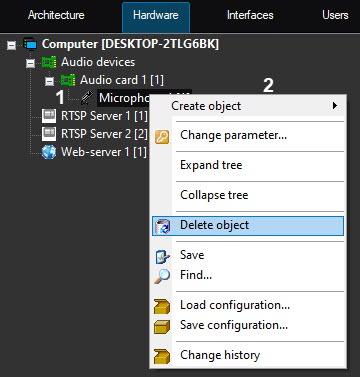
Select the Delete object item in the menu.
Note
Instead of opening the context menu or selecting the corresponding item, you can select the deleted object and click Ctrl+Del.
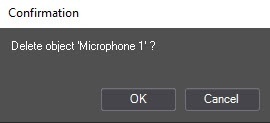
Then the window that requires the confirmation of the object deletion is displayed.
Click the OK button.
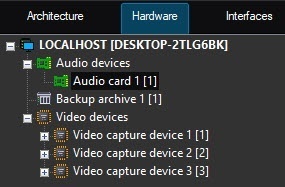
The figure displays the result of the object deletion (the object tree contents after deletion). The deleted object (the Microphone object in the considered example) is no longer displayed in the objects tree.
Note
The object settings are applied after you switch to another fragment, regardless of clicking the Apply button.
Overview
Content Tools