
Go to documentation repository

Documentation for Axxon PSIM 2.0. Documentation for other versions of Axxon PSIM is available too.
Previous page Next page

On the page:
The Tracker object registers the object tracks in the camera FOV during recording and saves them in the VMDA metadata storage.
To configure the Tracker object, do the following:
- Configure the basic settings.
- Optional: configure a mask to disable analysis in any parts of the camera FOV.
- Optional: set the size of the detected objects or configure the perspective settings (see Configuring perspective).
Basic settings
To configure the Tracker object, do the following:
- Go to the Hardware tab in the System settings dialog window.
- In the object tree on the Hardware tab, select the Camera object, corresponding to the camera, the video image from which you want to analyze.
- Create the Tracker object on the basis of the Camera object. The settings panel for the Tracker object is displayed on the right part of the Hardware tab.
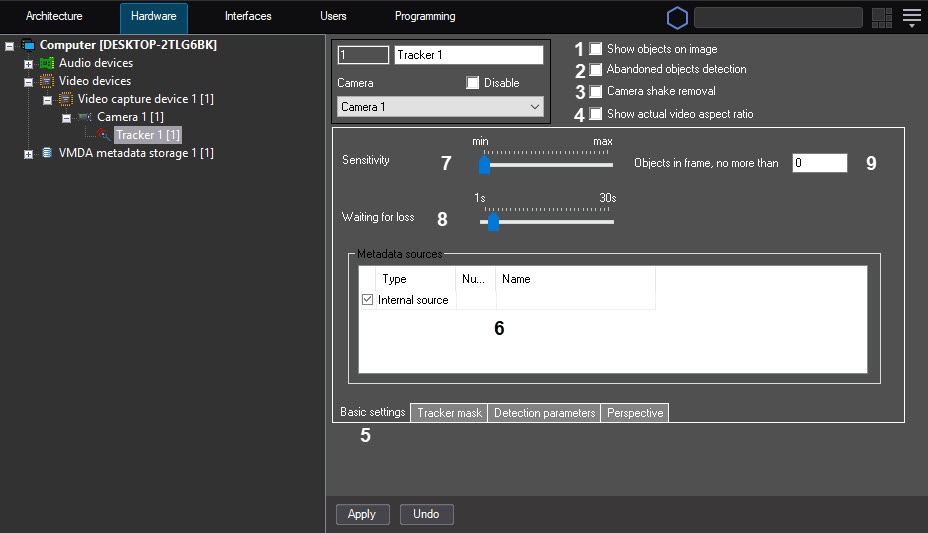
Set the Show objects on image checkbox (1) if you want to outline the objects on the video display. The outlines are displayed on live video only, for example, in the video surveillance monitor.
Note
To enable the display of IDs of tracking objects, you must set the 1 value for the DrawDetectorNumbers line parameter in the HKEY_LOCAL_MACHINE\SOFTWARE\AxxonSoft\PSIM\Video registry section (HKEY_LOCAL_MACHINE\SOFTWARE\Wow6432Node\AxxonSoft\PSIM\Video for 32-bit system).
Outline color is adjusted by the DrawDetectorColors parameter in the same section:
- When the value is 1, the outline color is the average color in the area.
- When the value is 0, the outline color is white.
To allow the VMDA detectors to monitor the objects abandoned in the camera FOV, set the Abandoned objects detection checkbox (2). The video requirements for proper operation of this feature are described in the Video requirements to be met for abandoned object detection tool of the Tracker object operation section, and the settings for VMDA detectors are described in the Creating and configuring the VMDA detection section.
Specifics of configuration:To ensure the operation of the Abandoned objects detection, you must additionally configure the Abandoned object detector type (see Motion in the Area detection tool configuration).
- By default, if you enable the Abandoned objects detection option, then when you view the live video and archive, only the abandoned objects and disappeared objects are framed on the video image at a time. If you want the VMDA detector to detect only the disappeared objects or only the abandoned objects, you must change the value of the VMDA.filterGivenOrTaken parameter of the HKEY_LOCAL_MACHINE\SOFTWARE\AxxonSoft\PSIM\Video\Vmda registry section (for more details, see Registry keys reference guide, for more information on how to work with the registry, see Working with Windows OS registry).
The function of framing the abandoned and disappeared objects on the video image is available both for the standard and converted fisheye video.
Note
If you don't want to monitor the objects abandoned in the camera FOV, we recommend disabling the Abandoned objects detection option to reduce the load on the server. If you disable this option, the detectors configured to monitor the abandoned objects won't work.
If you set the camera on the moving object, set the Camera shake removal checkbox (3) to stabilize the image and reduce the error in the detector operation.
Attention!
When you enable the Camera shake removal option, the load on the server increases.- If video proportions in the preview window are too distorted on the Tracker mask, Detection parameters, and Perspective tabs, set the Show actual video aspect ratio checkbox (4). In this case, the video may not occupy the entire area of the preview window.
- Go to the Basic settings tab (5).
- In the Metadata sources table, set the checkboxes next to the objects used for metadata creation (6):
- Internal source. The resources of the Tracker object are used as the metadata source.
Embedded detector. Metadata comes from the detectors embedded in the camera (see Embedded detectors).
Note
The recording of tracks from the embedded detectors must be supported by the device. Besides, this functionality must be integrated into Axxon PSIM.
Set the value of the Sensitivity parameter by moving the slider to the required position (7). The value of this parameter corresponds to the minimum value of the moving object's averaged brightness, upon which the detector generates an event only on its motion, not on the video signal noise (including snow, rain, and so on).
Note
If you set the slider to the far left position, the value of the Sensitivity parameter is selected by the tracker automatically.Set the Waiting for loss slider (8) into the position corresponding to the time when the object stops moving and during which this object is considered active and the detector still tracks it. If the object is motionless longer than the specified period, the object is considered lost.
Note
If the lost object starts moving, it is considered a new object.Note
To fine-tune the detector of the abandoned objects, use the registry keys (see Registry keys reference guide).
- In the Objects in frame, no more than field (9), specify the maximum number of objects in the frame that are detected by the tracker. If the number of objects is equal to or exceeds the specified value, then the MD_LIMIT event is generated (see CAM Camera section of Guide for creating scripts (programming)). If you don't set the parameter or it is equal to 0, this event isn't generated.
Tracker mask
To disable analysis in the area that is in the camera FOV, you must click the Set mask button (2) on the Tracker mask tab (1) and specify the area in the video preview area. You can disable analysis in several areas, that is, set several masks. To set an additional mask, click the Set mask button again and specify an additional masked area in the video preview area.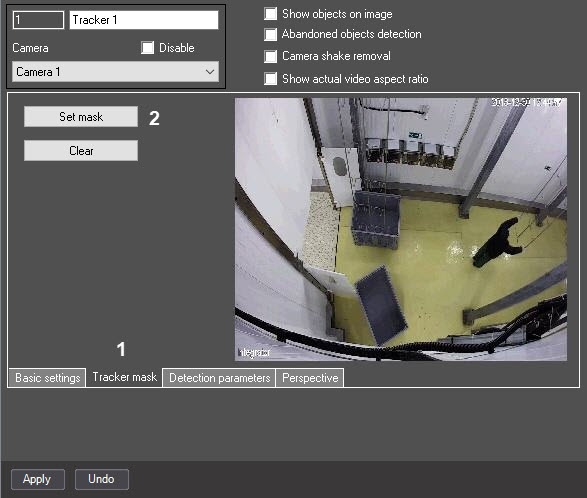
If, after clicking the Set mask button, you want to zoom in on the mask setting area for a more precise selection of the masked area, right-click the video preview area while holding down the Shift key on the keyboard. The video opens in a separate window, the size of which you can change by dragging its borders. After you set the mask in this window, close it by clicking the  button in the upper right corner.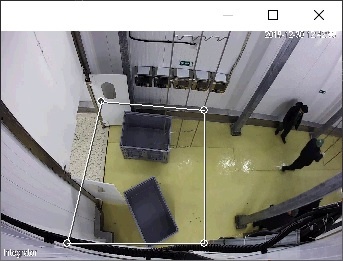
Detection parameters
To set the minimum and maximum size of the detected object, do the following:
Note
If you enable the perspective setting, the maximum and minimum detection parameter sizes are ignored. The Width, m and Height, m parameters on the Perspective tab (see Configuring perspective) are considered instead.
- Go to the Detection parameters tab (1).
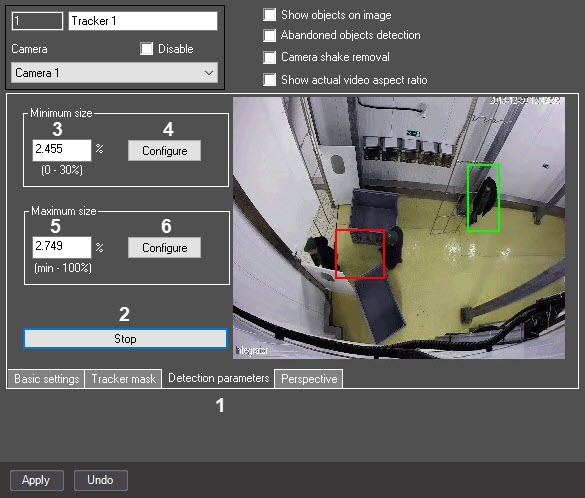
Click the Stop button (2) to stop the playback in the video preview area.
Note
To resume the playback, click the Resume playback button.
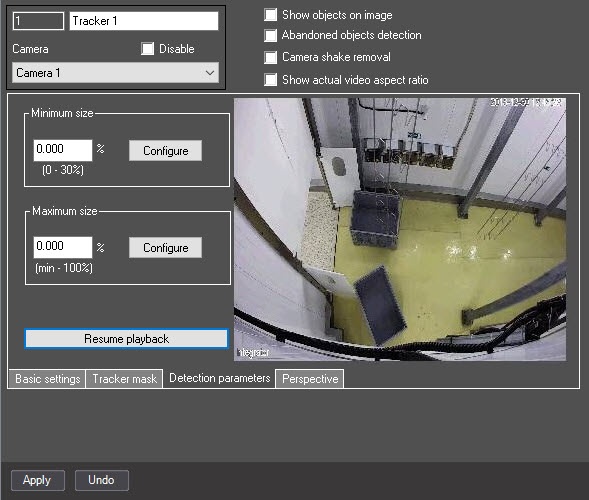
In the Minimum size group, specify the minimum size of the detected object as a percentage of total image area (3) or click the Configure button and specify the size in the video preview area (4).
Note
The range of values of the Minimum size parameter is from 0 to 30% relative to the frame size.In the Maximum size group, specify the maximum size of the detected object as a percentage of total image area (5) or click the Configure button and specify the size in the video preview area (6).
Note
The maximum size must be greater than the minimum one and not greater than 100%. If the maximum size is equal to the minimum one, detection isn't performed.
Note
To save the changes, after you complete the set, click the Apply button.
Overview
Content Tools