
Go to documentation repository

Documentation for Axxon PSIM 2.0. Documentation for other versions of Axxon PSIM is available too.
Previous page Next page

The telemetry control panel is used to control PTZ devices. To register the Telemetry control panel as the hardware device in Axxon PSIM, use the Control panel system object.
Note
Some of the PTZ control panels, for example, UNIVIEW KB-1100 are registered by using the Control device object, see Configuring the Control device object.
After you connect, register, and configure the telemetry control panel, the Key pressed events start coming from the corresponding Control panel object when you press keys, as well as other events depending on the control panel model—see subsections.
When you connect the telemetry control panel integrated into the Drivers Pack, you can use the Camera discovery tool to automatically register the Control panel object in Axxon PSIM similar to IP devices. The Axis T8310 and Videotec DCZ control panels are integrated in this way at the time of writing this documentation. You can configure their connection manually as described below. For the list of control panels that can use the Camera discovery tool, see the Documentation Drivers Pack.
To register and configure the Control panel object manually, do the following:
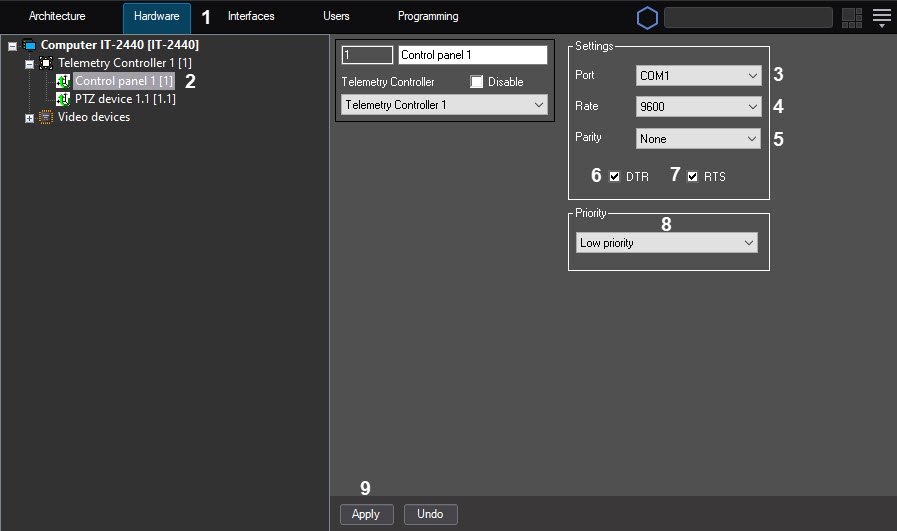
Go to the Hardware tab of the Axxon PSIM System settings dialog window (1).
Create the Control panel system object on the basis of the Telemetry Controller object, or select the corresponding object on the Hardware tab of the System settings dialog window (2).
Attention!
If you connect the control panel using the USB interface, then all settings related to the COM port are ignored by the system. In this case, go to step 8.
When you create the PTZ device object, you must specify the ID, the object name and select the Telemetry controller object to which the PTZ device is connected.
From the Port list (3), select the serial COM port number to connect the Control panel device.
Note
The control panel connects to the COM port different from the one used by PTZ devices. Due to this, you must specify another COM port number on the settings panel of the parent (for the Control panel object) Telemetry Controller object.
If necessary, specify the parameters of the data exchange rate between the computer and the Telemetry control panel device (4).
If necessary, change the parameters of the bit parity control at the data exchange (5).
If the Telemetry control panel device is passive (that is, the power isn't supplied independently), you must activate the power supply of PTZ devices via the outputs of the DTR or RTS serial COM ports by setting the DTR or RTS checkboxes (6, 7).
Note
The COM port rate and parity settings set for the parent Telemetry controller object don't relate to the similar settings of the Control panel system object, as they refer to another COM port.
Note
The values of the Rate and Parity settings must be the same as the COM port settings in the Windows OS.
If necessary, change the PTZ device control priority by using the Telemetry control panel device. For this, select the required item from the Priority list (8).
To save the changes, click the Apply button (9).
Overview
Content Tools